Blog

The Non-Digital Look with Lenses like the 50mm f/1.4D, 85mm f/1.4D and 135 f2 DC: Character, Not Specs

The Non Digital Look - 85mm f/1.4D Nikkor fits the bill. Screen Danger - 85mm f/1.4D prime lens.

Introduction

On this website I have previously written in detail about my ethos when shooting people. The advent of high resolution camera sensors combined with ultra sharp lenses, means we have to be very careful these days otherwise we can easily obtain nasty 'digital’ crunchy looking images; with an unnatural feeling to them. Having an in-organic feel, and being too sharp and crunchy is one thing; we also see the general tendency for many to simply over process images. Here, I want to go into more detail on this subject and talk about some of my three favourite lenses I use to achieve a certain rendering in the final picture. Why am I still using ancient lenses in this day and age, you might ask? Well, I hope to show you why. Keep in mind, we are talking portraiture here, while sometimes posed, however more often a documentary style, in the moment type of shooting; sometimes with pure available light or speedlights / reflectors and other light modifiers. You can be sure that for other genres, for example landscape and astrophotography style shooting, I would be using entirely different lenses optimised for those conditions, so please bare that in mind. Consider when looking at any of the example photographs here, that the images are compressed for the website, and as such, aren’t as sharp / high quality etc as they will be natively on a large monitor or if we observed them printed. This is in order to allow the website to load in a reasonable time for all readers.

Arcade Girl - 135 f2 DC Nikkor

Vision

When shooting portraiture, generally I do not prioritise sharpness / ultra sharp lenses, and certainly not as much as the average photographer seems to. (No, this doesn’t mean I leave motion blur in images - maybe I am too used to photography forums?). I find most modern primes to be sufficiently sharp for the task of portraiture, so this really is a lower priority on my list. Heck, I find most old primes to be sharp enough. In fact, most prime lenses ever built are sharp enough for me, especially when we are talking about 50mm and 85mm lenses. This is because optically, they are quite simple designs to produce and achieve good results. I have a saying - ‘if the lens feels soft, your light isn’t right.’ It is so true. (Even an ultra sharp lens looks soft if the lighting is wrong for the shot: try it and you’ll see I’m right on this one). I need to reiterate this basic point whilst we are talking about image sharpness, for me, even babies with perfect skin look better with a slightly softer lens that produces some level of spherical aberration at it’s widest apertures, essentially, to be shot with a lens that is tuned to being used for portraits. Spherical aberration is a biggie when it comes to portrait-tuned lenses; over correcting it in a lens design tends to adversely affect bokeh and the focal plane transition. It can also sometimes give a crunchy looking feel. This aberration goes away as we stop down, so lenses that have high correction tend to be very sharp from their widest aperture, and conversely lenses that are a bit softer and have a glow wide open generally are under corrected. With the 50mm lenses that I own: I use them on both full and crop framed sensor cameras, giving either 50mm or 85mm equivalent views respectively. The 85mm lenses of course end up as a much longer FOV on crop sensor cameras, around 135mm in fact. I like a good spacing between the primes I use, so mostly I am at 50 - 85 and 135 in order to get this. (Sometimes on a crop body, but mostly used on full frame).

Why is it that I prefer ‘softer’ lenses to shoot people with? Well, if we consider portraiture we have to remember a few things. Take weddings, which are at their very essence, a series of documentary style portraits / environmental portraits for the most part. Wedding clients tell me again and again what makes a good picture for them, and I hear the same thing from them time after time. That they look good in the picture. Yes, that’s it. Sadly, many will perhaps, at least not at first, notice your masterfully constructed composition, or the way in which you have worked the light; they might note your impeccable timing (because of course, they know it’s a good picture because you caught the moment, and that is a skill in itself) however, this is what the initial impressions of most are, and we must remember and give it weight as photographers’. Make no mistake, they may eventually see a lot more on reflection, however to start with, what they want is to look good. This is where I start.

Nikon D810 and 85/1.4D Nikkor

When we observe people in our daily lives, our family, our friends, our brains don’t tend to study or labour on their flaws and faults. Their skin, the crows feet they have, the wrinkles around their lips. This is crucial. because in constructing a beautiful portrait of someone, we need to keep that in the forefront of our minds. Camera sensors are of such high resolution now, and lenses so ridiculously sharp (they have their applications, landscape photography, astrophotography), that we start off with something that disconnects from the reality I am speaking about here. Our brains don’t see these things. When we take a portrait, we capture an instant in time. Look at any of the famous 17th and 18th century painters. Do you see what they did? Do you think the people actually looked like these paintings in terms of 100% accuracy of the depiction? Of course not. Most of them are romanticised viewpoints, and rightly so: they understood their purpose in crafting a beautiful portrait of someone. Of course the resulting painting still looked like them, just them on a very good day, in very good light and in a flattering pose / position. This is one big reason, I like to start closer to this goal when shooting. I can already hear people mumbling at their screens to simply ‘soften it in post’ or jump through this or that hoop. Yes, we can try to do these things, however, clearly, they have not shot weddings! It just doesn’t work as well, or indeed how they think it will, and it is absolutely not the same as using one of these lenses here that I recommend to get a specific look or rendering. This is where, at the very least, I would if using an ultra sharp lens with a high resolution sensor, consider a mild softening filter at the time of shooting to bring things into line. ‘Prosofton Clear’, or ‘Prosofton A’ (stronger softening effect) are viable options, also useful for astrophotography use to bring out constellations. I use these regularly, however, none of the pictures here have any filters applied and while do have some post processing to dodge and burn the light and whatnot, most are very lightly edited, which is my particular ethos for portraiture.

NB: My ethos in landscape shooting is different. The reason being, in portraiture, we should be able to get the light as we need it, or right for the subject at the time of shooting in a singular frame. If we are using flash, be it strobes, speedlights, and whatever light modifier / diffusion we are using: we have control over that process. Further more, it’s easy to capture the full dynamic range of a portraiture scene most of the time. If we do things correctly when shooting a portrait, we should have much less to do in post processing unless we want to do a very specific type of edit, like for example a fantasy style of editing. This is not the case with landscape photography, and it’s why those types of pictures require much more input to get them to look realistic to the scene. I don’t know of any stills cameras that can do 24 stops of range in order to do what I am asking, so I take multiple images often and exposure blend them. There is simply no other way to create realism in landscape photography.

Holding Hands - 85/1.4D and D800

Understanding Light and Post Processing

These two are prerequisites which take years to become competent at, and most shooters continue developing their entire shooting career; constantly improving and refining their methods and workflows. This is probably true of all crafts. We constantly learn and evolve, even if we don’t properly realise that we are doing so. I am a shooter that uses mostly available light, however do not think that means I don’t know how to light a scene: I am a dyed in the wool wedding shooter in my beginnings, I used to read a lot of Neil Van Niekerk of ‘Tangents’ and I own many of his books. I love using on and off camera flash, and when needed small soft boxes and umbrellas come out. I think pushing yourself to learn flash photography to some degree really lets you understand available light in a deeper way, and in learning flash photography (even if you just do the basics) will ultimately improve your available light shooting techniques. Sometimes available light sucks, and you have step in and make your own; so you might as well learn the basics of that craft for those situations. As mentioned, available light is something I just use more of, simply because the way I photograph is very much a documentary style when it comes to people, and I mostly like to travel light, without speedlights or other lighting equipment for the most part: their are exceptions of course. (Often, I’ll just take x1-2 prime lenses and a reflector). Generally speaking, I don’t pose most of my photographs’ although there are exceptions to this also.

Post processing is something that most shooters constantly reflect on. Heck, if most of us look back to our post processing from 10 years ago, we might not be happy at what we find! Understanding how to use editing software to the best of our ability to create the pictures we want to create is ultimately a big ticket item, alongside crafting the image at the scene. So let’s get this out of the way: ensuring we have favourable light on our subject and we can process competently for the images we want to create matters more than what lens or camera you are going to buy. Never forget this simple truth, because it’s forgotten time and time again when the gear gets in the way.

* Let me show you a set of lenses that play well together *

Nikon 50mm f/1.4D Nikkor

50mm f/1.4D Nikkor

This shot of my son is a fairly good example of what I am looking for in a picture of this genre. This was shot at ISO 400, 1/80 at f/1.4 on the venerable Nikon D810. I should have shot this at ISO 64, as I have burned the highlight a touch more than I would like on the hair, however, the moment always trumps perfect settings. If it happens, you shoot, you don’t adjust and play with ISOs.

Do you see the glow in this shot? It’s not added in post. Above that radiator in the background is a large window, allowing beautiful overcast daylight to backlight the scene. Because I have went for the full effect here, shooting at f/1.4, I have a lot of spherical aberration glow going on across the entire image. The process of editing was simple - I constrained it to lightroom. I mildly modified WB and tint, I added some mild global contrast via a curve with no black-fade, I put the shadows and midtones where I like them. I masked and dodged a little (just gently), I very gently upped the vignette to bring out some details and make the image pop more. I think I was maybe fifteen minutes until I got this how I wanted it to look. (sometimes I try different approaches of editing on each image).

Climber - 50mm f/1.4D

The 50mm f/1.4D Nikkor is a lens I fell in love with over a decade ago (must be about 14 years actually). I’ll start by saying that this lens is not optically perfect, and this is no surprise. It was a 50mm lens that pros used in the film days in the 90s and 2000s. What actually attracted me to this lens was the overall look from the files (or as photographers’ call it, the rendering). It is so far removed from how modern lenses reproduce a scene. This lens is pretty well built; yes it incorporates high quality plastics and it has a metal mount. There is no weather sealing, and the barrel extends when focusing close or far. It comes with no lens hood, however it is easy to attach a foldable rubber one if so required. It has several ‘optical flaws’, it being an older design from the 1990’s. It flares much easier than modern 50mm lenses, (and with that, contrast drops if flare occurs), it’s contrast is low wide open, (and it especially looses a fair bit of contrast in contra-light situations as you can see here). It is what many would call ‘soft’ wide open by todays standards. Heck, this is something that has never phased me, because I barely even sharpen any of my work. I just don’t like the look it gives. (Most of my images are left at a very low 40-60 default in Adobe’s Camera Raw, depending on the thickness of / or presence of an anti-aliasing filter in camera). In addition to the softer look this lens provides at maximum aperture, it comes with bags of spherical aberration at it’s first aperture. This literally looks like a glow that runs across the image and can vary depending on the direction and quantity of the reflected light in the shot. It can be controlled by stopping down just slightly and it dissipates quickly in doing so. The lens vignettes fairly heavily at f/1.4, and quickly improves. Most of my work leaves the vignettes’ in from each particular lens. I consider it for the most part, integral to the draw of the lens (rendering). This 50mm lens has quite a lot of of chromatic aberration against high contrast objects in harsh light, which leads to spherochromatism (purple or green coloured glow around the focal plane area). This is an optical flaw that can be controlled in post processing to an extent. It can also be controlled by stopping down, however it can be significant and we need to be mindful of it when shooting. It’s bokeh is gorgeous in the right circumstance, in others it appears to be what some people would describe ‘a little nervous’. It is definitely unique. Everyone is going to have an opinion on this. Most of the time, I like the bokeh. Sometimes I don’t. This is true of mostly every lens I own. Modifying the actual background, or subject to background distance, or camera to subject distance, are fairly simple ways to improve things if you are not happy, however. It gives a fairly nice 3D feel to the image overall. Let’s even dare call it, that it has some 3D-Pop…

The Bridesmaid. A good example of the SA Glow in the 50/1.4D. (D810)

Strengths / Weaknesses of the 50 f/1.4D: For me, this is a lens to shoot people or things with during the daylight hours, although it can be used in other circumstance of course. Consider my thoughts in the ‘Vision’ section of this article and you will see why I like this lens. It’s not too crunchy / sharp wide open. I absolutely abhor that look in modern photography, especially when it comes to portraiture. That crunchy-gritty look does most people no favours. The shots with modern lenses are often highly post processed in order to tone that down, especially if they have shot their subject stopped down a lot. This is a very lightweight lens, such that on any DSLR the combination feels like there is no lens is attached - a definite plus in most shooting environments. In terms of weaknesses, night is perhaps one I would note. At night, this lens has such under corrected spherical aberration (SA), that the glow becomes too much. Combined with the high contrast nature of night time lighting, CA also rears it’s ugly head and it can get a bit much. That said, with care, it can be used, and used well, stopped down. With a speedlight and a stopping down, I really love the retro heptagonal ‘stop sign’ bokeh that we get behind the subjects when we move off of the first aperture. (If you want round, even stopped down, and a more safe rendering at night, look at the 50/1.4 or 1.8G variants). Another potential weakness could be the softness out with the central zone for daylight portraiture; when considering very off axis compositions, such s when using quadrant framing (think ‘Mr Robot’ cinematography), your subject may appear a little softer. I have not personally found this to be a problem however, and find that overall I am pleased with the look I get from the lens. This for me, overrides any concerns. Do note, that I own x3 50mm primes currently and I have a zoom that also covers 50mm! I can simply switch to a different type of rendering if I really want it for the picture I am looking to make.

Tip: If you are a cheapskate, grab the 50mm f/1.8D. It is quite a bit cheaper, and it’s 85% of this lens and it is another 50mm lens I own and love. Plus it’s even lighter…

Stop Sign Bokeh when stopped down to f/2.5 here


The 85mm f/1.4D Nikkor on a D800 body

85mm f/1.4D Nikkor

This above picture, made with the 85/1.4D on a D800, is one that I shot many years ago. I took this picture stopped down to about f/2 because the girl was so close to me. This was an attempt to get more depth of field and detail in both eyes; I should have perhaps considered f/2.8-3.2 area however, since her right eye is slightly soft. For me, this isn’t something that makes this a bad portrait however. I think it almost adds to the melancholy of the shot, a sort of ‘glint in her eye’. I have said previously that, as photographers’ we have to make judgements and when shooting documentary style portraiture as I am showing here, we cannot be missing shots over absolute perfect settings. That of course doesn’t mean we shouldn’t have a serious grasp on exposure and all the rest of it, what I mean is if a shot presents itself, don’t be worrying about slightly lowering the ISO setting to get a bit less noise in the end shot. By doing this, you will just miss the shot altogether. That’s a whole lot less noise you just got! There is a saying, make hay while the sun is shining. It’s never been truer here. Knowing how to meter a scene, and how to expose properly is paramount. These should be intuitive functions to the seasoned photographer, and if you are learning, this should be your ultimate goal.

A huge Bokeh Panorama built with the 85/1.4D

When I speak about the 85mm f/1.4D, a lens which has been with me for about fifteen years (the same lens, still working like day one), I mean this when I say: there is no other lens like this one; apart from it’s cousin which we will get to next. When it comes to shooting people, the 85 1.4D is legendary among portrait shooters of yesteryear, and it still holds it’s reputation to this very day. This is a lens that was designed for good skintones, bokeh and focal plane transitions and it shows all these years later. Again, this is not one of your ultra sharp modern lenses, however, it never produces soft looking results, providing the light is right as previously mentioned. This lens is built like a piece of military equipment. It is made with a lot of metal, some plastics and a metal mount. It was one of the first designs of it’s type to internally focus (Nikon designate that with ‘IF’ on the lens). It’s never skipped a beat in the around fifteen years I have owned it. I will admit I do baby lenses, so mine still looks as new, despite it being used regularly over the years.

Formal Stair Portrait - 85/1.4D With strobe camera right through large umbrella using manual flash at ¼ power

Speaking about the nitty-gritty…The 85/1.4d has fairly controlled spherical aberration for the standard of it’s time, however it is obviously not as well corrected as modern lenses are in that regard. (A good part of this was by design, in the knowledge that this would help bokeh and the focal plane area to look it’s best for this type of lens - this is still a serious consideration in modern lens design and the top optical designers are aware that correcting too many flaws can lead to other issues rearing their head). The lens does not produce a ‘glowy’ scene, to the same extent that the 50 does wide open, however that look it still there. (This can be both good and bad. If you want out of control glow, switch down to the 50mm f/1.4D prime lens in this article). The 85 has high level’s of coma and chromatic aberration by modern standards. The higher coma, is actually advantageous for bokeh qualities though and is also by design here. The lens has basically zero distortion, at just -0.6%. Not noticeable to the human eye I find. Just what we would want for compositional options when shooting. Vignette is high wide open, and quickly drops off as we stop down. This is a fairly normal phenomenon for lenses around even today. The 1.4D has incredible bokeh - this is of course what it is really known for. Bokeh balls are large, stay rounded throughout the range and look impressively cinematic in images. I’ve never seen any shot that had poor bokeh or anything but buttery smooth focal plane transitions.

I’m not sure I like the cliched modern lens look, for portraits. In fact no, I am sure. I don’t like it. When shooting people, I want a softer approach, a glow, a glorious bokeh, a painterly feel; a characteristic that the 85/1.4D achieves so effortlessly that it really does make the things we photograph appear like a 18th century painting. Why you might ask, do I want something like this? Is this not backwards thinking? Well, ask anyone you can name (let’s start with non photographers for a start), and you tell me if they want to look unique, dreamy and characterful, or do they want to be displayed at 45MP with an ultra modern lens that says it is tuned for portraiture on the box, but really would be better to be relegated to landscape shooting because it resolves so much fine detail that every single line on their face is shown in that single frame? I think for most, the answer is obvious. The reason for using this lens is obvious. It gets me to a finish point with a portrait picture much faster than other kit would. I don’t have to blur everything down, out of the box, I am so close to how I like to display image that I only do very basic edits to get things where I want them. (Very different to astro and landscape shooting - I wish this were possible! Due to huge shifting dynamic ranges and things like tracking - that’s rarely possible).

Strengths / Weaknesses of the 85mm f/1.4D: If you are a portrait guy, or a wedding shooter and know what you are wanting from an 85mm focal length, you may already know if this lens would fit the bill for you. There is also a perfectly capable 85mm f/1.4G version which they made a little sharper and has an inbuilt motor (pros and cons, that motor will wear out one day and paperweight the lens), but IMO Nikon lost some of that rendering I love in the first 1.4D version. (The 1.4D version focuses faster than the 1.4G, just like nearly all G lenses in the short prime arena, most of the AF-D’s beat them at autofocus speed by a long and noticeable way). I’ve also found that despite the marketing speak, AF-S primes aren’t really any more accurate in their focus, for the most part, compared to the older AF-D counterparts which use on-body screw driven motors.

Tip: If you are a cheapskate, (and can deal with manual focus), look at the some of the other 85 options in the Nikon eco system for that analogue look, the 85/1.4 AIS for one.

Brown Eyed Boy - 86/1.4D and D800


Giving Her Away - 135/f2 DC Nikkor on a D810 body. Shot at f2 and R0.

135 f/2D DC Nikkor

Nikon’s 135mm ‘defocus control’ nikkor is one that is very well matched to using alongside the 85/1.4. There is a 105mm version of this lens, however it makes very little sense to own it if you already own an 85mm lens. The 135 DC is, much like the 85, a legendary optic, with a unique system of being able to influence bokeh with an additional ring on the lens. (More on this soon). When Nikon brought this lens to market in the 1990s, they developed it with a special consideration for the red channel of light. Through some magic which I will admit off the top of my head I cannot remember right now (edit - must add this part in later), the 135 f/2 just makes skin tones look gorgeous. It’s effortless. It’s made from the ground up to shoot people, and it shows! The Nikon 135mm f/2 DC lens defocus control function works by using a special internal element group that separates from the main lens, controlled by a dedicated DC ring, to manipulate foreground and background bokeh independently, allowing for dreamy, creamy out-of-focus areas that standard lenses can't achieve, creating a distinct subject separation by being able to adjust the lens spherical aberration. Combined with the focal length of 135mm, this allows for some great compression of backgrounds, and much tighter portraits of people. The defocus control side to this lens is often misunderstood, so let’s explore that right now. This ring is independent of the aperture as mentioned, and allows control of front or rear bokeh. Used in it’s normal setting of ‘0’ or neutral, the lens functions like a normal fast telephoto, with a balance to the front and rear bokeh. As expected, the rear, or ‘R’ setting affects blur behind the focal plane. Setting this to ‘R2’ or ‘R4’ for example, will shift the internal elements to slightly increase the blur here, making it softer and more pronounced (it definitely increased the glow we see, which as mentioned we call spherical aberration). The effect is subtle, but noticeable to the discerning photographer. Setting the lens to ‘F2’ or ‘F4’ does what you would logically expect it to do, affects bokeh in front of the focal plane. In oder to use the lens effectively, it’s best to match the DC ring to the aperture, or have the aperture smaller than the DC ring at all times, or you will encounter severe SA and glow to the final picture. For example, shooting at an aperture of f/2.8, ensure you are at either ‘R0’ ‘R2’ or ‘R2.8’, If you set to ‘R4’ while shooting at an aperture of f/2.8, the lens will glow like crazy. You can use this effect creatively as you see fit. Ambient or added light greatly effects how this all plays together, so it needs time and patience to master. This really is the takeaway of this lens. Yes it can be used as a simple fast telephoto, however for those willing to take the time to really master it, the rewards are there for those that do so. Let’s look at a simple example of the DC lens in action with the aperture set to f/3.5 speed on the lens, with the ‘R4’ setting on the DC ring (slightly ignoring my own rules here). Click for a larger view on desktop, or tap, pinch zoom on mobile to see:

135 F2 DC shot at f/3.5 Aperture. and ‘R4’ DC

Closer view. Look at the glow. No other lens looks like this.

If you have not shot with this defocus control lens you may still have a lot of questions. Sadly, many of them won’t be answered until you sit down and learn how to get the best out of this optic. What I can say is there are a few common misconceptions about it. Every photographer knows that using a 135/2 lens on a full frame sensor at average subject to camera distances, shot wide open, tends to render a lot of background blur. So it is reasonable to ask, why even stop down at all and start changing the bokeh with the rear setting? If we want the best bokeh (or most bokeh) why not just use f2. Well. it’s more nuanced than this. Shooting down at f/3.5-5.6 as I do with this lens, then applying some rear effect, gives back that beautiful SA glow that old lenses have. You can really see it on the above image and hopefully the crop gives a better view of the look achieved when doing this. Some will not appreciate this effect and that is fine, the lens can be shot plain-jane too. I use a mixture of settings when using the lens, and have spent many hours with it over the years.

Bride and Son, 135/2 DC with Nikon D810


Strengths / Weaknesses of the 135mm f/2D DC: 135mm primes are outdoor lenses to me, or for headshots in doors (usually with additional lighting I might add). There are of course many options nowadays at this focal length. What the 135 f2 DC does differently is that it offers an ‘old school’ rendering, matching the 85 and to some extent the 50/1.4 nicely in this article. it’s major strength would be it’s reproduction of skin tones. On the weakness side, it is an older lens so do not expect it to consistently track fast moving sportspeople (not the right lens for this) however for the most part I find it’s autofocus is competent on a pro level DSLR that I am satisfied. I am not something that will loose sleep over a tiny focus miss now and then either. (Yeah, that used to be me, until I learned what I know now - although we strive for perfect focus, sometimes a picture is slightly out but simply too great to ignore. Is the Mona Lisa completely sharp?).

Tip: If you are a cheapskate, look at the many other 135 options in Nikon land, for example their older 135/2.8 AIS manual focus glass.


Fast Glass - There is No Substitute for Aperture!

I have always been a shooter that appreciated fast aperture glass. From the moment I held a proper camera, as soon as I ditched the ‘slow’ zoom lenses I was happier. This want for aperture has stayed constant for me right until this day. I cringe when I hear shooters on forums tell me that we don’t need fast lenses now because ‘high iso is so good now’. That statement shows a naivety to understanding the properties of light and how they interact to produce good images. I like fast primes for many reasons. Number one on that list is the sheer flexibility they bring to the shooting equation. With 1.4 lenses I have four times more light than a 2.8 zoom has. This lets me be free of flash often and to work solely with available light. They allow me to isolate subjects much easier, and produce more cinematic images as a result. Although I work with available light a great deal, in the past I have spent a huge time and trouble learning to use strobes and speedlights and all the various diffusers available. I encourage anyone to learn manual flash, beginning with on camera TTL flash, right up to a strobe on full manual, in manual shooting modes. Anyone that does so, will become a better available light shooter by nature. Learning to bounce, diffuse, flag and control light and ultimately understand how it interacts with our cameras and lenses is crucial in this game.

Bride and Bouquet - 135 f/2 DC

I have seen many people in forums talking about how they needed to upgrade from f/1.4 glass to the newer f/1.2 lenses Nikon have pumped out. I used to want 1.2 glass when I was looking at Canon’s offerings from the Nikon ecosystem. Their 50/1.2 used to call to me, as did their 85/1.2. (By the way, these are both legendary optics, however this is not solely because of their apertures!). I fully expected myself to lust for this when Nikon went to mirrorless, as I knew they’ve offer them. (Nikon previously only had a manual focus 50/1.2 because 1.2 glass is a little difficult to get around the narrower dimensions of the F mount, compared to Canon’s EF mount of the time). When the time rolled around and we saw Nikon produce as expected, a bemoth of a 50/1.2 (optically great of course) and in the same vein, an 85/1.2 and a 135 1.8. Consider I already own what works for me - the multiple 50s (at either f/1.4 or 1.8 speeds), the 85/1.4 and the 135mm at f/2 speed. Changing purely for aperture was something I worried I would do on a whim, however when it came about I had a rethink. I was glad I didn’t even want these lenses. (The bank account was also fairly glad about this also). When we look at the difference between f/1.4 and f/1.2 speeds, it’s not as big as a difference between coming from an f/2.8 or slower zoom, down to a fast f/1.4 prime. And, for that half a stop or under extra speed that a 1.2 lens provides over a 1.4, often they vignette so heavily you really aren’t gaining a huge amount anyway, however the weight seems to skyrocket (especially to keep these, optically superior). Although I don’t personally like the shift to these types of lens, I do not have any ill feeling about it. I am glad to live in a time where there are so many options that I can find exactly what fits right for me. You might ask, what if all this stuff breaks one day? Well, we can cross that bridge in time, however, there are so many places that can repair this stuff, and so many copies in mint condition ready to be snapped up on ebay that it won’t matter. And if, which I do not for a moment believe, there are no bodies or lenses that work anymore in this vein and I cannot get repairs, then I will explore other options that best fit my needs then. No matter what system was required to shoot them.

Movie Star - 85mm f/1.4

Noise

There are two main types of noise we need to deal with, read noise - which is the noise created internally by the electronic gubbons of the camera, and read noise - the inherent noisiness of the light itself that even our eyes can pick up on, in certain situations. Read noise is something that varies camera to camera. Check out Photonstophotos.net to learn more about which cameras do well in this regard, and to gain a deeper understanding of this topic. I want to talk about shot noise here. Noise, like sharpness, is probably, I would say, the second most discussed, debated, pondered thing on internet photography forums. And heaven’s above is it dull to hear about over and over! From what I am seeing currently, noise reduction tools (AI and otherwise) really kill the realism of a photograph for me. Do me a favour and go back and look at the initial image here. (I can put up a flickr link as it will display a lot better and as intended there). I dislike the way websites compress the natural noise range in an image however this shot, in this case still looks pretty good. I am here to tell you, I barely did anything with the noise in this image. Bit of shot background here: I used the fast 85/1.4D to capture the available light at the scene, being careful to compose so that the background light struck the top of his head, the phone light illuminated from below (to give a mild ominous vibe) and that the background was left dark as it was on scene. My settings where 1/100. f/1.4 and ISO 3200 (it did need a boost in post as all high ISO shots often need, so consider this around ISO 6400). I made sure baby was placed with good separation to scene elements and in a logical place in the picture. (I think of bokeh and backgrounds not as something to just lazily ‘blur away’ but something to compose the subject around physically. This always makes for a better image). The resulting final picture looks extremely analog. It could have come off a film camera of yesteryear. By using heavy handed noise reduction, most of what I am seeing online tends to produce overdone, plasticy skin, no grain structure from the natural noisy nature of the light and it just absolutely kills realism and mood to me. I do wonder why everyone copies each other now in this regard. We are all so into our AI denoise stuff - it’s mostly ugly and increases for me, the digital look of the resulting file. That’s a look for the most part, I want to avoid.

Outdoor Girl - 135 f2 DC

Final Thoughts

Shooting with lenses as old as this might sound crazy, and you might feel I am stuck in the past. Perhaps I am! However, the only thing that matters is I feel at one with these lens. I’ve spoke before about my dichotomy between landscape and portraiture / weddings. I use completely different lenses, because I have completely different goals in the pictures that I make with them. We should never confuse these lens types! It must be said, I am also a cheapskate when it comes to considering buying another product when I already have something that works the way I want it to. Buying all these lenses again for mirrorless bodies doesn’t make any sense because of that simple fact, and DSLRs are cheap now, the D800. and D810 are reasonably priced for the amount of camera you get. They drive these lenses well. There is also the more than competent D750 etc.

I am in the slightly unusual situation whereby I am using modern, class leading zooms / some primes (20/1.8S) for landscape photography, and by those standards, ancient prime lenses for portrait with a range of optical flaws that when we correct, the lens isn’t as nice of a portrait lens for me anymore. These principals still govern modern prime lens design. Computer aided lens design allows a lens maker to test many different configurations quickly, whereas in the past this was simply not possible. Many lenses have sharpened right up; however something has been lost in the process to the overall look. I am not advocating that you should blindly follow my way; however if you get where I am coming from, you will probably understand why I am still shooting with lenses like mentioned in this article to this day. I never advocate simply copying someone else. If you feel like trying these lenses make sure your thoughts at least in some way align with mine. I extend this to other lenses I have tried from other systems over the years in the Canon and Sony ecosystems. There is a lot of old glass that is just perfect to photograph people out of the box that we have perhaps lost something quite characterful which old glass tends to bring to the equation, in the quest to achieve that ‘optical perfection’.


If you enjoyed this article, consider following me on Instagram or Facebook.

Steve


Flickr, What Has Happened To You?

One of several images that back in 2011 got me noticed by Getty Images via the app ‘Flickr’

Flickr and Why I Love It

I want to preface this by telling you how much I love Flickr, and how much it pains me to see it in it’s current state: confused, lost, and ultimately on life support. Flickr is a website (and app) that allows a user to add images to a sequential photo stream, organise via albums (previously called sets if you are a longstanding member), add titles, descriptions, keywords, tags and photo exif data and comments, all while displaying images in the best possible quality across mobile and desktop platforms easily to the entire world. It also functions as a nice backup, and allows sharing and embedding images in other places such as forums and other apps. It allows lots of other cool functions other apps don’t have, such as allowing private folders we can share with friends or family. Many members allow their photos to be viewed by anyone, forming a large collaborative database of categorized photos which are easily searchable via keywords, that should exist in full up until the present (more on this later). In short, Flickr is very useful all round and I still use it regularly to this day.

I first jointed Flicker in 2010, after I stopped playing with my Father’s old Pentax ME Super film camera and bought a Nikon D700. Flickr back then, was a ways away from how it is now. Those were the days when myself and others got noticed by Getty Images and started a journey in stock photography work, along with several other avenues and opportunities that go along with this. I love the layout (which Flickr don’t constantly change like other apps, it’s kept for the most part - clean, although that might be due to limited resources), the EXIF setup for each photo is key and separates Flickr from other apps, the groups and the display format: photographs are correctly resized, pop out when clicked on, and we can add annotations. I still get a little burst of excitement when I feature on the front page of Explore, of which I have been privileged to have been featured over 70 times now! (Explore featuring is a big thing on Flickr, the algorithm there constantly scans for images that should reach Flickr’s front page and be displayed to a vast, worldwide audience. In short, being featured on it makes one feel like Flickr Royalty!). In short, Flickr is designed as a photographer’s app from the ground up. Created in 2004, it has went through many iterations, and it has changed ownership several times now. The popularity of Instagram and Facebook has coerced many away from Flickr, however the story is more nuanced than simply ‘something else came along that was better’. Many of the changes that have been made have really driven people away also. The current owners are still seemingly constantly playing with the app’s implementation and alongside other functional problems, are ultimately doing disastrous things that won’t convince anyone to use it, or bring the masses back to it.

So What Went Wrong?

Sadly, Flickr has had several falls from grace. ‘Yahoo!’ acquired Flickr in 2005 for around 22 Million USD. In December 2006, upload limits on free accounts were increased to 100 MB a month (from 20 MB) and were removed from Flickr Pro accounts, which originally had a 2 GB per month limit. In April 2008, Flickr began allowing paid subscribers to upload videos, limited to 90 seconds in length and 150 MB in size. On March 2, 2009, Flickr added the facility to upload and view HD videos, and began allowing free users to upload normal-resolution video. At the same time, the set limit for free accounts was lifted. In 2009, Flickr announced a partnership with Getty Images in which selected users could submit photographs for stock photography usage and receive payment. It then eventually evolved, giving photographers’ they thought viable, actual full-time contributor contracts with them and as mentioned, it is how I got started.

In 2018 it all went sharply downhill when current owners ‘Smugmug’ (yes, terrible name) began their premiership. Flickr, was then seen as a dying App (Yahoo! did not wish to sustain ownership because of this, and apparently it was becoming costly to run with little to no upside as most flocked to more regular apps such as Facebook and Instagram), Smugmug began to put in place measures they thought would get people paying for pro memberships and using the app again. One of those changes that really alienated the faithful users at the time (myself included) was when they decided to limit all non pro accounts to 1,000 uploads, even if at that time a user had say, 10K worth of images on their account. (Previously, free accounts had 1 TB of storage which to most users at that time was essentially unlimited space). Too bad they said, and they gave a date of when the system would physically delete the users’ images, gone forever. The initial deadline was February of that year, however they pushed it to March due to the outcry. They didn’t change course as many hoped. It caused me to physically delete my entire Flickr account with them. I’ll admit, done in a sort of “up yours” fashion at the time, however looking back I would have still done the same today. It was and is the most significant faux-pas Flickr management has ever made. If you recall, I touched on this at the start of this article by explaining Flickr’s importance as a historical record, essentially digital history for all types of photograph, from personal to archival. One of their major founding principals was broken that day.

Their logic on the face of it made sense to them at least; force people to pay up or they would be heavily restricted from every angle. The problem is, Flickr had a ton of loyal photographers’ who cherished the site, using it daily, and spending many hours on the forums, in the groups, and researching locations, guides and watching their friends shoot. It was a big thing. Many were there from the start, and suddenly they left en-masse. I know what you are thinking; well, if they love it that much, pay up! There is just one inherent problem with that thinking. Flickr is an app now that has a very small userbase compared to the big players and they are free to use, with unlimited uploads. So you want people to pay money to reach less people, with less functionality and all the rest of it? I do not see that strategy playing out well here…The problem is of course, that Flickr plain and simply always touted themselves as a place first and foremost to store images, and this change of direction in regards to stingy limits placed on free accounts, really left a sour taste. Let’s consider what is going on now, as of 2025, because it’s gotten a whole lot worse in recent times.

Connecting Waters - One of my first decent landscape shots out of the D800 camera back in 2012, also noticed by Getty via Flickr

Flickr Today

Now Flickr is almost unrecognisable compared to it’s inception. The 1,000 upload limit remains of course. But Smugmug went further. They are not content that a free user can only upload 1,000 images before they hit a wall, oh no. Now they have limited downloading of the full resolution file by anyone but a pro subscriber! This was an extremely handy function, and now it’s gone. (Consider that, Flickr has always touted itself as a backup service also, and now those pictures are held at ransom until the user pays? Is this business strategy working Smugmug?). There is now as of December, an annoying, never-ending popup message the user has to click on to make it go away telling us the following:

“Your activity shows you're already engaged! Pro membership gives you unlimited storage, ad-free browsing, detailed analytics, priority support, and connects you with fellow photographers.
Join Pro today!” A button appears below this to upgrade to pro, with another saying “continue without supporting”.

“Continue without supporting” - that’s right Smugmug, make them feel like terrible people! That will get them on side. surely. You might say, okay, well just pay, or just click it away. The problem is, it literally comes up constantly, it’s not just a “once per session” popup. It also prompts you again every single time you upload any image. It is extremely annoying and unnecessary, it’s completely spammy. People don’t come to flickr to get harassed like this, and if they feel like they are being, they’ll likely leave as fast as they arrived. Like a used car salesman telling a prospective buyer that four others are interested and that you’d better buy this little beauty now before it sells to someone else. Does this tactic work on anyone? Harassing people into sales: I would imagine this practise has a very low hit rate. The fact they keep coming up with more crazy ideas in this vein would suggest I am correct.

Eilean Donan Castle - Dornie, Scotland

Workarounds

As mentioned, one change that really frustrated me was the lack of access to the full resolution file. This is handy to be able to send to friends, use for prints, Instagram and other app sharing functions. They not only limit the user downloading the full size, the maximum resolution able to be downloaded is now ridiculously small and essentially worthless, somewhere in the region of 1 MB or less! The workaround is a pain, but doable. On any browser, right mouse click over the photograph on flickr - click “inspect, or inspect element” then find the larger size. It won’t show the user the full resolution, but at least you’ll be able to access the 4 MB file for a bit more resolution (remember, that’s the version that shows on higher resolution monitors, so there is no way they can stop this function at least. I do however wonder if Smugmug will nuke Flickr with one final stupid change: make the display format ultra low resolution, just to block me from doing this workaround?). Where does this end? I use Flickr to post to other apps regularly, so this workaround is a pain to do on a phone, Most of the time I can screenshot the image, then crop it. It gives a higher resolution than downloading their measly low resolution file they limit access too on mobile. The second workaround which makes it possible to bypass the 1,000 upload thing: just make another account. It’s simple: I have three, proof ultimately that these restrictions are an act of self harm to themselves. (By the way, Flickr allow multiple accounts, so it’s not like this is even against their rules).

My Message to Flickr

I understand the catalyst behind some of these changes, and perhaps even some of the intentions come from a place of thought and reconciliation. Many I feel though, are simply mean spirited, and at the coal face of it, will never, and were never, going to bring anyone back to using the app. Annoying people into paying, limiting things that were long since free and consistently restricting that down further and further, year by year, along with badgering constant popups in their faces and badly placed ads will never been a strategy to do so. I understand Flickr has to survive and remain viable, but there are better ways to do so. Flickr needs to ‘mettre en mouvement’ certain things to fix some inherent problems that are so glaringly obvious to it’s success: lift the 1,000 image limit for free accounts. Honestly, it’s so measley I am sure it stops people even bothering to sign up in the first place. Put it at 10K. A proper ‘pop up’ messaging system like any other app is sorely needed. At the moment I gotta ‘email’ a user like it is 2001. (By the way, they need to fix the constant spam and phishing a user receives pretending to be from flickr). Flickr must stop the constant popups that come about when doing absolutely anything on the app. Stop pestering people over and over to sign up for a ‘pro’ account every second they are online. It won’t convince people to sign up, it only has the opposite effect: it drives the user away.

Despite these greivances, I simply cannot get over my love for the website. You might tell myself and other users who are waivering or long lost, “why not just shut up and pay up”. I hear you. You have your point, to a degree. However, consider that Instagram, Facebook, and the likes do not charge to play. I have a rule about never paying for social media, and I won’t ever do it. Because of this simple fact, the majority are simply not going to pay for this type of thing in 2025. Flickr is inherently different to these other two big players. Flickr is a pure photography app, whereas Instagram for example, is overrun with adds and plenty of non-photographers and ‘influencers’ that is seems more like a popularity contest on those apps. We have to consider these other two have a much greater pull, and are always going to generate higher ad revenue than somewhere like Flickr will ever be able to attain. Flickr must find a way to be relevant in today’s space with the likes of Instagram and Facebook, in a scaled down manner. This is indeed the quandary that Flickr has now. The best strategy is to fund it entirely with advertising and consider how places like Meta bring in the revenue. This model ensures no one has to pay to play, but of course other ‘things’ are for sale then aren’t they? The quandary and hubris Smugmug have here, is the fact that they might not have the numbers required in order to make that approach viable. That said, I am convinced the answer to Flickr’s woes is not to beg, annoy, disappoint and restrict the last few users who actually value it in some way though, is it? Please. I beg you: stop doing what you are doing to Flickr. It doesn’t deserve this.

If you enjoyed this article, consider following me on Instagram or Facebook.

Steve

Flat Calm. Gourock, West Scotland in 2012. An over 6 minute long exposure which helped get me noticed via Flickr for Getty Images

How I shot Comet C/2025 A6 (Lemmon) over Scotland

Comet over the Witch

Introduction

C/2025 A6 (Lemmon) is a non-periodic comet discovered by the Mount Lemmon Survey in images obtained on 3 January 2025.

The Witch

In 1657, legend has it that a woman suspected of witchcraft was burnt here during the Scottish Witch Trials. Records show that around 6–9 women were condemned as witches and were killed in this small village of Dunning. For me, this place is a testament to the every woman that died during the witch trials that went on around the world hundreds of years ago.

C/2025 A6 (Lemmon) is a non-periodic comet discovered by the Mount Lemmon Survey in images obtained on 3 January 2025. It won't visit us again for over 1300 years. Needless to say, this was my only chance to photograph it.

In order to show the comet with all it's detail, which is only just visible in dark sky locations, and fairly small in terms of angular size in the night sky; I shot it on it's own with a fast telephoto lens to gather the structure and huge ion tail behind it. I decided to leave it like this rather than shrink it down too much as it looked to grand shot up close. The shooting and processing of an image like this is a huge task and takes time, no matter one's experience level. Including shooting, it must have totalled about 8 hours minmum.

Shooting the Sky Mosaic

I obtained this picture in the village of Dunning, Perthshire. Because it was clear the second time I arrived here last night, I got immediately to concerning myself with shooting the sky and not the foreground first (cloud could scupper my shot at any moment). This is generally speaking, the way to go about taking shots such as these. I used a Nikon Z8 with a Tamron 35/1.4 lens. This is a spectacularly well corrected lens on starlight, which can be shot wide open at f/1.4 (which is exactly what I did, because cloud was an issue last night). A 35mm f/1.4 lens isn’t always associated with astrophotography (particularly with beginners), however it is an excellent lens to get tighter on deep sky objects, asterisms, constellations, and the milky way. How I used it last night, was to make a panoramic image to encompase the same field of view as the foreground would end up being. I did 30s exposures in vertical orientation, ISO 800 at f/1.4. I took five of these, with generous overlaps. This was all done on my polar aligned Star Adventurer tracker mount, in order that I got perfect stars right into the corners, and great detail.

Shooting the Foreground

I shot the foreground with a 20mm/1.8S nikkor. I ensured that I would obtain the same field of view as the sky mosaic. I shot at ISO 800, 2 minutes, f/1.8. I choose this aperture, because I wanted a nice depth of field falloff, and had nothing important in the corners to concern myself with. I made sure that focus was on the grave, as at infinity this area would not be in perfect focus.

The Technical Side of obtaining a Deepfield Comet Picture

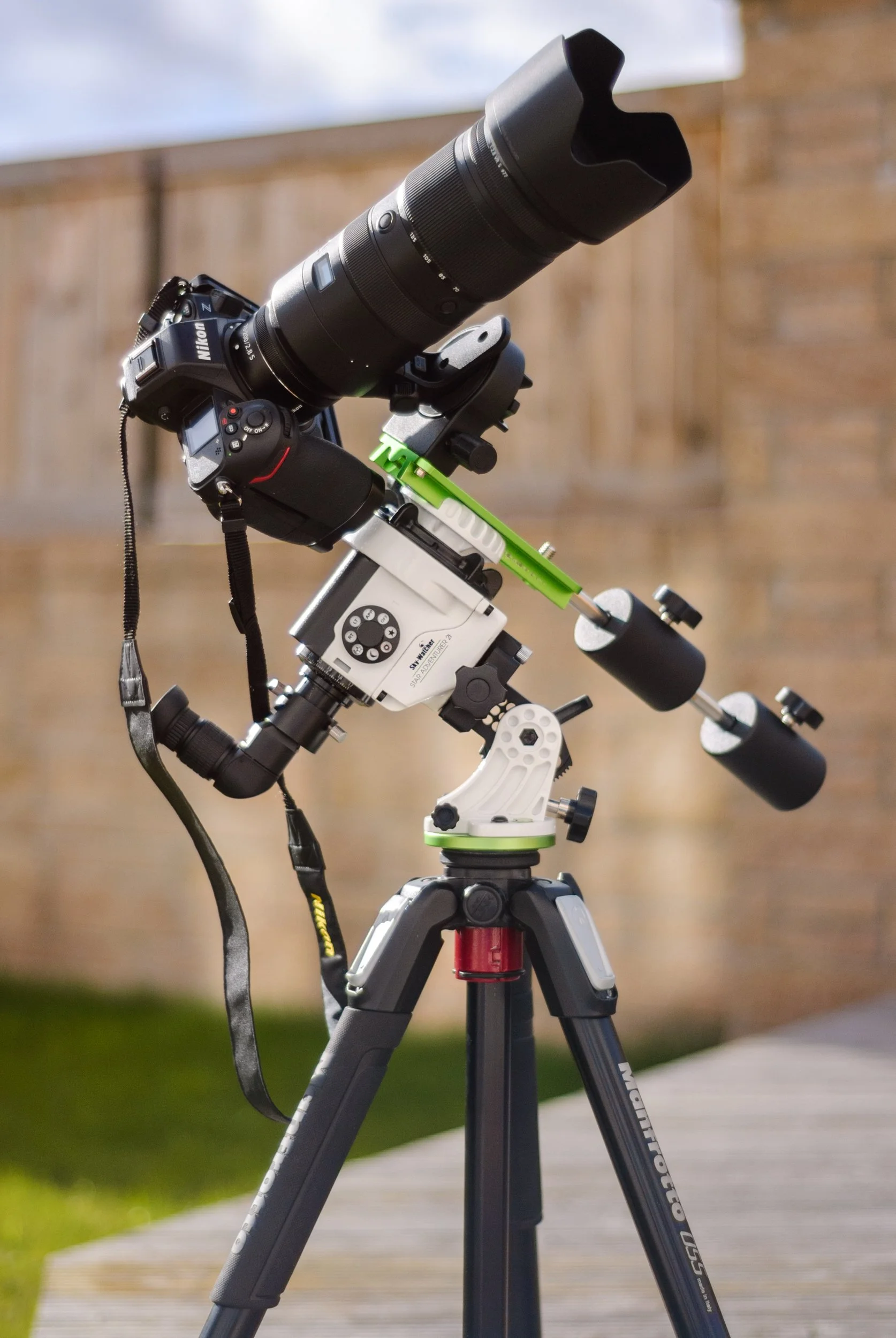
To image the comet you see embedded in this panoramic picture, I used a Nikon Z8 camera with their 70-200/2.8S lens on a Star Adventurer star tracker mount. I use the ‘pro pack’ version with wifi for this mount, which allows me to properly balance the payload with the counterweight kit onto the top of the mount. This is essential in order to do any sort of deep sky, or ‘magnified’ close up images of celestial objects such as comets or galaxies / constellations. I took approximately 50 pictures of the comet on it’s own at 200mm. I used about 43; seven having some light cloud obstruct the view of the comet during the exposures.

I shot the comet as mentioned, at 200mm with the following settings:

  • Aperture of f/2.8

  • Exposure time of 30s

  • ISO of 800

I will address these in order. The widest aperture is always where we should use the lens for comet imaging. Forget worrying about lens aberrations and the stars in the midframes corners, at least for now. The most important point to hold in your mind is that we need to collect light and fast. We do this by having the largest aperture. This concept is called clear aperture and you can read more about this online if you want to understand it in a deeper way as it relates to astrophotography. This brings me nicely to the exposure time. The other way we gather light, is clearly via exposure length; in fact these are the only two variables that influence the final collected light. (ISO is a digital boost for the most part, and does not change the physical light collected during at exposure). Lastly, the ISO of 800 was selected because it is sufficiently low enough as to protect the star cores from blowing out to white during the individual sub exposures, and because it, along with the aperture and exposure time, created a histogram with the data bump being approximately 1/3 from the left wall. We have to be really careful here. I am often slightly under this, to protect the stars blowing out to white, which doesn’t tend to look great in the final picture. Notice that I have picked up the individual star colours in the final shot above? Let me be clear here, that the Star Adventurer mount is capable of easily doing one minute tracked sub exposures at 200mm. In fact, I’ve managed two minutes with accurate stars. I’ve even pushed to over two minutes before…

This is a very good result for only approximately 21 minutes of total data. The more data we get, the better the image can be, technically speaking. You should always aim for this, however sometimes cloud, rain or life stops us from going any further. This image could only really be improved from a technical standpoint by increasing the number of sub exposures that I can stack together in post processing and / or by moving up to a telescope with a larger effective aperture. (Remember that aperture is a ratio of focal length. There are f/11 scopes with greater aperture than my 200/2.8 lens which has approximately 71mm of aperture). We can surmise this via the basic equation:

Focal Length / lens aperture ratio = effective aperture for light collection

So imagine I used an 800mm telescope with an f4 aperture. I would have 200mm of aperture to gather light. Significantly more aperture, yes, however with that comes the demand for significantly more equipment, accuracy and alignment. And of course…expense and weight! For me, there aren’t enough clear nights in Scotland in my opinion for me personally to take this side of what I do any further as I already split my clear nights between landscape astro, and deep sky shooting already. I do absolutely enjoy every minute of maxing out what I have. There are of course limits of what a 200mm lens can resolve, with regards to the physical size or the ‘angular view’ of the object in the sky. The smallest of objects need more aperture and focal length, that’s just the way it is. I find it extremely satisfying to max out or ‘use up’ every possible trick in the book to create the best picture from the equipment I own, in a carriable sized package.

Here is the latest shot I made of the comet over Scotland:

Comet C/2025 A6 (Lemmon) Over Scotland

If you have ever shot a comet at 200mm and tried to frame it over a landscape I applaud you. This was an extremely difficult picture to pull off, both in execution at the scene, and in post processing. High wind gusts made tracking at this focal length really tricky and I shielded the setup as best I could. I tracked the comet at 200mm on the Star Adventurer mount, even capturing the faint pink glow of aurora. After I managed 70 frames of the comet, I shot the landscape directly below it at the same focal length.

The comet was shot at 200mm, f/2.8, 30s, ISO 1600.

The ground was shot at 200mm, f/2.8 for 4 minutes.

The processing was extremely complex. I've never shot a comet that wasn't this way, especially if we want to get the absolute best detail possible in the faint tail. (I binned a lot of frames with too much motion blur). 200mm / 2.8 gives a good amount of aperture to suck in light for these tasks. (71mm).

If you enjoyed this article, consider following me on Instagram or Facebook.

Steve

Autumnal Milky Way over the Hermitage - How I made the Picture

Milky Way at Black Linn Falls, Hermitage, Scotland

Introduction

I recently visited Black Linn Falls at the Hermitage in Perthshire to make this picture. In order to produce an image such as this, takes great physical effort and technical knowledge. In this series, I am going to explain what it takes to pull this off.

Plan

I knew that the milky way extended around to the south west direction in autumn in the northern hemisphere; this is what began the idea for the shot. I used ‘PhotoPills’ to give me a general idea of alignment, and Google Earth Pro. Photopills is a wasted opportunity to me. It gives some advice on alignment, however the VR function is pretty useless. It doesn’t allow the user to see the milky way (or object) over the landscape you are going to be shooting in, which is what we really want. It literally just randomly overlays it in your house in the VR mode that it has: not that useful, I mean, I don’t care what the milky way looks like over my television set, right? You have to physically go to the location to see what will be, which defeats the point when planning. I was in touch with the app maker about this two years ago to advise and they advised they where planning to do what I asked; implement the VR element over the shooting landscape, however that still has not surfaced as of it. To be honest, although I go with a rough plan, I am not a planner. I find it stifling and boring to have a rigid idea of what I want. Sometimes I never know what I want; but I know what I don’t want, image wise. The best app overall is ‘Planit Pro’. This is a subscription app with a per monthly payment, however it does just what I ask and need: it lets as see the landscape with the milky way overhead, and at different focal lengths.

The alignment of the milky way seemed to check out that at around midnight, whereby the southern milky way would align up over the falls. I arrived much earlier than this, in order to hike in, test equipment, and get ready to shoot.

Equipment

Star Adventurer 2i Star Tracker Mount

This is essential for any landscape astrophotographer to be able to capture the greatest, most detailed views of the cosmos. I always have this with me, every night. With an ultrawide angle lens of say 14mm, we can easily do 10 or more minute exposures. Even around 35-50mm, we can do multiple minutes of exposure easily without star trails showing up in our images.

Nikon Z8

I used a Nikon Z8 to capture the sky of this image. The Z8 has a very useful function that is also present in Sony land, whereby it allows us to see the starlight and landscape much better than in the past. Nikon call this ‘Starlight View’. When enabling this function, it assists physically seeing the scene, and enabling the shooter to focus. I used the Z8 to capture the sky frame on the Star Adventurer mount.


Nikon D810

I still use DSLR kit, because technically speaking there is absolutely nothing wrong with it. The images produced, will be exactly the same. The major reason I used it this evening, was because I had the Sigma 14/1.8 Art attached to it. Perfect for capturing the ultra dark foreground with the aperture collecting over double the amount of light that my 14-24/2.8 will.


Sigma 14mm 1.8 Art

The Sigma 14/1.8 is a lens I still use regularly, particularly during large auroral displays, but also in other situations like here. In this particular case, I used it for collect the foreground scene, using the f/1.8 aperture. At f/1.8, this lens is sharp enough to collect a scene like this when shooting wide open. It took ten minutes of exposure to begin to register the foreground at ISO 800! Any fall off in sharpness in the corners is fine, we don’t want to be directing the viewer into the corners of the image, etc.


Nikon 14-24/2.8S

I used the Nikkor natively on the Z8 body of course. This allowed me to achieve excellent quality starlight at 14mm. I have no qualms using the 14mm Sigma to do this either despite the higher astigmatism and coma that it has wide open, however as I will explain later, this was about streamlining the shot and time it took to make it.


Other Stuff

I use a Gitzo Mountaineer series carbon fibre tripod and a Manfrotto 055 aluminium tripod with the star adventurer mount. I do not use remote timers (more on this soon), and on the Z8 enables selection of predetermined exposure times in body which is helpful also. I use L brackets on all my cameras for astrophotography and landscape photography. I am using a Smallrig L bracket on my Z8, for example. The reason I do so, is that it place the centre of gravity right over the tracker when using the camera vertically.

Arriving on Scene Setup

Upon arrival, I checked out the best possible area to shoot and went about polar aligning the Star Adventurer tracker. I then arrived at a composition that I wanted to show and fitted my D810 with the 14mm f/1.8 Sigma lens. I was then fixed in place after this, by design. I dropped the monitor down to about minus 3 to protect some night vision and also to allow me to judge exposure better (with histogram enabled of course). I enabled long exposure noise reduction in camera. This takes a black frame of the corresponding time of the initial exposure and subtracts it in camera, meaning it cancels out most of hot pixels that can show themselves over an ultra long exposure time such as used for this shot (ten minutes). After composing, I focused and then put the camera to timed mode (not bulb or 30 seconds). Bulb is useless unless we use remotes, and I personally hate using remotes at night in this day and age, and 30 seconds was going to be no where near long enough exposure time to make the shot. Timed mode allows us to use exposure delay mode, which I enabled, then after we push the shutter, the exposure proceeds until we press the shutter again. You might think that would cause problems with shake, however I have never found that and others will confirm that this is the case. As long as we carefully roll a finger over the shutter to end the exposure, you will obtain a sharp picture. This is a liberating way of working, freeing us of using pesky remotes in the dark. After selecting mirror-up mode in combination with exposure delay, I began the exposure in manual mode. My settings where as follows - aperture of f/1.8, exposure time would be 10 minutes, with an ISO of 800. I set my watch for 10 minutes and after that time passed, I pushed the shutter button again. The camera then switched into long exposure noise reduction mode, which means it was out of action for a further 10 minutes. A total of 20 minutes to take the foreground might sound excessive, or perhaps even ludacrous, however to do this to a high level is what it requires.

I then turned my attention to my other camera that I brought with me, the Nikon Z8. I mounted the Z8 to the Star Adventurer, enabled the red light mode, dropped the screen brightness, put the camera into manual mode and focused on the bright star Vega, which we can see on the right of the image. I turned on the star tracker, after confirming good polar alignment and set the exposure delay mode to 3s, manual mode, and selected 3 minutes at ISO 800. I nearly always select an ISO of 500-800 on the Z8, due to the dual gain point, which reduces read noise in the electronics whilst shooting. I kept the aperture at f/2.8 - the Nikon 14-24/2.8 is stellar at this focal length on starlight, stars remind round and decent quality right into the corners. I made sure I was at 14mm on the zoom ring. I now had obtained both the foreground and sky for the shot. Sometimes I will take three tracked sky shots and stack them, and this is a good way of doing things, however on this night I did not.

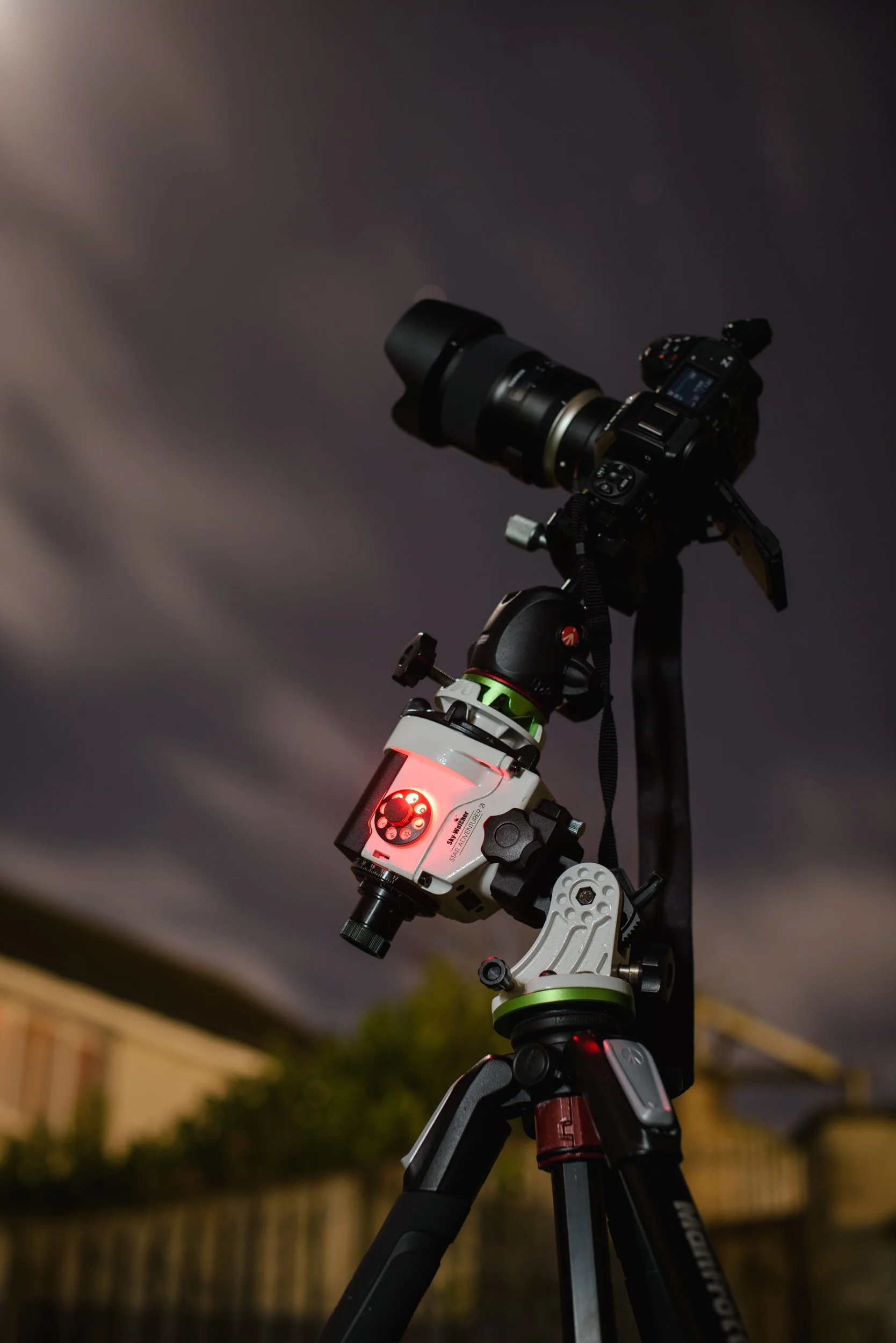
The venerable Sky Watcher Star Adventurer has helped me make most of my night sky pictures

Processing

Now the work really begins. And I do not say this lightly, or imply that this image is fake. I say this because, technically speaking, every night sky image is a composite, and potentially nearly every landscape image is that has contrasty light. Why? Well, because they nearly always require multiple exposures to get the best fidelity in the final picture. Even with a fast aperture lens, it is impossible to capture the night sky in high detail without doing multiple minutes of exposure. Try shooting the night sky with single shots, which means no long exposure foreground, and a short sky exposure. Let me save you time and tell you that the result is only pleasing at very small sizes, and sometimes not even at that. The night sky is a little light-starved!

Editing of the Tracked Sky Exposure

I tend to edit the sky exposure first, however it really doesn’t matter which way we do it. I tend to import the expsoure into Photoshop via a smart object and do some basic camera raw adjustments to it before I stretch it. To learn more about stretching, which is a whole topic in itself, see my other tutorial here. As I stretch the image, I feather the stretch off so that it impacts less on the horizon then at the mid portion and zenith of the sky. I do this because nine times out of ten we are dealing with some horizon light pollution, so we don’t want to brighten this in most instances. As I stretch, I select the stars and apply a colour preserving stretch. I split the stars and background from each other using StarXTerminator. This allows me to pull out the faint detail from this patch of the night sky which is much more subtle in it’s details than the milky way core is for example. Having the stars on one layer, and the background on another, lets me perform again, some basic camera raw global adjustments, further background stretching, and some colour / light pollution fixes before recombining the two. Before I do so, I can display the stars how I want them by applying a curve layer above the stars only layer and using a clipping mask in order to reveal more or less stars in the final result. I do not use minimum filters, as this produces bad artefacts even when done subtly, and this method works a hundred times better so I find it is now completely redundant.

I pull the file to reveal more than our eye sees (because our eyes see very little compared to what is possible). However, I like to stop before it becomes garrish, like we would expect a seasoned shooter to do in any other photographic discipline, for example Landscape Photography. I do not shoot with astro modded cameras for this reason. I believe that these images look very odd to the final viewer, especially if they are not astronomers or astrophotographers such as we are. The average person has no idea what nebulae are, and it often looks like a fake AI generated result to many. I want to avoid this as much as possible. I think these views of the cosmos belong in deep sky astrophotography, which I also enjoy. I leave these views for that. I am about editing to display the feeling, the twinkly dreamy night impression that I get when I am on location. I simply don’t think about the nebulae up there, for the most part, when doing these types of shot. Final steps include a final noise reduction, applied lightly using NoiseXTerminator. We shouldn’t need too much noise reduction if we have good data, and haven’t pulled it to riduclous levels (remember, that these things will bring out noise as we process).

Editing of the Foreground Exposure

To ensure realism, we need to make it that both of these pictures play together nicely. There are many points we should consider in order to do this. One of the major ones, is relative brightness. If you want the final result to look as natural and as real as possible, we much realise that the sky has to be brighter than the foreground and land below it. If the scene below is edited brighter than the sky, it is instantly un-natural, so tread carefully. Next is colour. We must ensure our white balances are the same, or at the very least show some semblance to one another. This is easily tackled in camera raw, before import, or when in Photoshop, which is where I edit this exposure also. Of course we can adjust the sky and foreground after recombining them in the next step, however it is best to get them as close as possible to how we want them before doing so. This will help prevent artefacts and halos at the places they intersect and are masked together. The foreground exposure is nearly always brightened in post using the exposure slider, curves, and selective white adjustment, often with some local masking. Be careful of using the shadow slider. Adjusting shadows upwards, will bring out noise extremely fast, even on ultra long exposures in dark places. Consider why you would want to brighten a shadow in a foreground? We do not want the viewer gazing into back shadows. I will usually do a curve adjustment and fade off the blacks at the left most side of the histogram. I do this, because it matches what our eyes see in shadows at night (barely nothing) but it prevents them going to clipped black, which most of the time you want to avoid as it can again, throw artefacts into the finished result. If there is a horizon I level it, if I find it is not sitting correctly. If there is distortion present on objects (perspective distortion, not lens distortion), I will sometimes correct this. I didn’t here. The tree on the right leans slightly (though admittedly, not as much as implied), however fixing this would have affected the bright star sitting by it - Vega, and it doesn’t really detract from the end result. Because I shot with long exposure noise reduction enabled, there are very few hot pixels to clean up, and the file should be clean provided a long enough exposure was used. The rule is, you think long is enough? Go longer…You can nearly never get enough exposure on the foreground, particulary in ultra dark sky locations - which stands to reason. After I get the file close to done I look to finish the image.

Combine and Finish

After saving both images independantly, I bring them both into Photoshop as smart objects. This is important, because it means that we can tweak them on the fly in camera raw, in order to make them blend correctly. We can make a selection of the land, then refine it in the select and mask workspace. We then apply it to the file. Often this will cause issues we need to fix. The most likely will be that haloing appears around objects where they both intersect on each other. This can be fixed by opening up the brighter exposure, and pulling down the highlights in camera raw, saving, then watching the intersection improve and the halo dissapate. For some images however, especially ones that involve ultra complex scene objects such as trees in my example, involve an even more complex masking solution. Enter Luminosity Masking, which is what I used here to recombine the images. This allows me to select the dark foreground and get finer control of the branches and leaves. We still have access to Adobe camera raw as long as we imported the files correctly, in order to adjust the files that will intersect one another in the mask to be able to produce a convincing, high quality result. I do not sharpen most of my work, other than the very light sharpning applied in camera raw, etc. I find digital images are too sharp out of the box mostly, and it is a look I want to avoid. Sharpning itself introduces halos and other problems also, which then takes steps to mitigate and clean up.

Final Thought

The total edit time for this shot is approximately three to four hours. That might sound absurd, however like I said before, this is generally what is often required to edit a complex scene to a high level of quality. Part of this time is also taken up by trying certain things that perhaps do not work so well, then going back in the workflow to try something better or different. Even despite my experience level with landscape astrophotography (and I’d imagine many other shooters too), it still isn’t a quick process. Rushing tends to not be advantageous to obtaining a good end result I fine.

I hope you have found this useful and please note I offer an editing service which includes the full photoshop file to be able to reconcile and understand each individual step, with email support for any questions as how to do something, or to ask questions on why I am doing something. Despite being for the most part completely self taught, the fastest way to learn something to a high level is to watch someone who is already doing it. I would have got where I am a lot faster than it took me!

If you enjoyed this article, consider following me on Instagram or Facebook.

Steve

Nearly Every Day I Consider Dropping Mirrorless for DSLRs Only

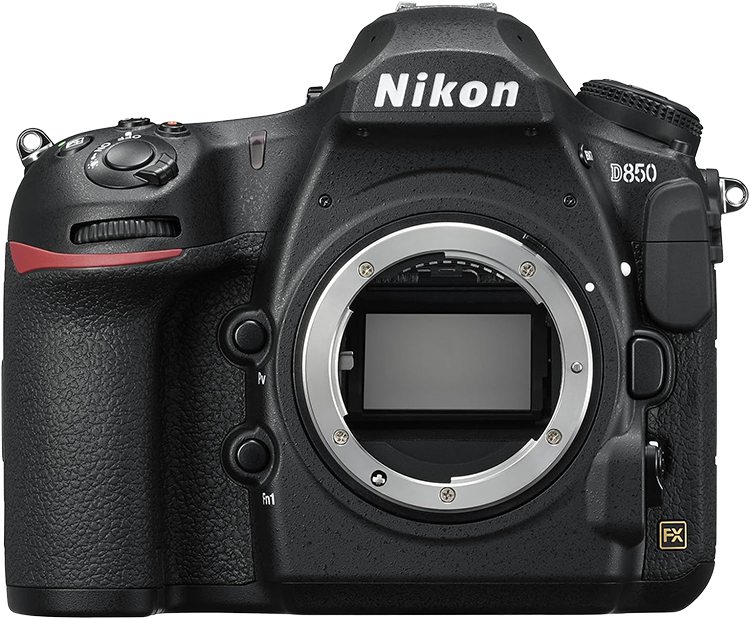
Nikon D850 - the best DSLR ever built

The D810 - most of the D850 for less money

The New Z8 Mirrorless offering

Introduction

If you have visited my gear section, you will see I still own a variety of DSLRs and mirrorless camera bodies. I’ve always essentially reconciled the following fact: I can do what I do with cameras 10-15 years old easily. One of the reasons for this; I simply do not require the bells and whistles of modern mirrorless. However, it goes deeper than this. Sensor technology has really not improved much at all since the 36 megapixel design that came along in 2012 with the D800 body, and a few years later, in the D810. For me, this is existential, because I can and do literally still use these bodies today and notice zero difference in the final result. In fact, sometimes the newer mirrorless designs are slightly more noisy (Nikon Z8 has more noise containted in the RAW data due to it’s stacked sensor design). Here I want to consider what using DSLRs would mean going forward.

Pros and Cons

You may know I have written about the pros / cons of mirrorless and DSLRs already. As I read my own words, part of me still feels ‘gamed’ by the consumerist, marketing machine that we are all wrapped up in. I’ve already stated that because I don’t need anything more than fairly basic autofocus (even for my wedding work), that the only real thing that matters to me is the sensor tech and camera reliability - dependability. I already had this. Despite this, I need to be fair to mirrorless; I did gain things with the Nikon Z8. I get access to more modern lenses, USB charging, advanced autofocus for those times I might need that. It’s much better at night. What do I mean by this? Well I mean ergonomically. The screen, the liveview, I can see what I am shooting. It’s much easier, it is. However, it’s not impossible to shoot with say a D850 in the dark. I mean I did it for nearly a decade and I was absolutely fine. I must admit I really love the Nikon D850 overall. It is an extremely advanced, back-side illuminated sensor with extremely low noise, high detail and good colour output. The RAW files have phenomenal pull-ability, it is a camera that absolutely has the best 35mm format sensor ever. As mentioned, it even edges out the Z8 slightly, and the Z7ii (it has no focus grid burried in the data etc).

The Things I Had Not Considered

Through time certain things have come to realisations about mirrorless camera technology.

One of the very obvious things about mirrorless is the fact the sensor is always on whenever the camera is operational. Mirrorless cameras literally show a ‘live-view’ electronic readout of the sensor, there’s no optical finder to look through. This actually means that mirrorless sensors tend to degrade much faster than DSLR variants, because they are always on, all the time, when the camera is being used and the wait time between each picture, that sensor is on, whereas DSLRS can be used without sensor activation right up til the point of taking the physical shot. (Of course, it’s a similar situation between the two in astrophotography, as the live view is used on the DSLR, typically). So what do we notice? Nikon have included a remap pixels option in their mirrorless line, and they know fine well why they are offering this. I notice that pixels burn out and die much more in these sensor designs. Whilst I don’t expect them to die any time soon, I really doubt in 20-30 years they will even function, or function close to how they were at the start of their life…(I know to many this might sound strange, but I am still shooting with a D700 that has a sensor that functions without issue from 2008). I like my stuff to last, and old antequated concept I know, but that’s me. I thrive on such a mantra.

Further to the above, sensor technology really hasn’t improved much in over a decade. The biggest advance has been back-side illumination (present in the D850), which basically reduecs noise by improving signal to noise ratio. The most recent ‘advancement’ is the use of global shutters. These are ultra fast sensors that read the entire sensor at one time, meaning no unusual effects, banding or in video modes, any jello effects. However, they come at a huge cost; their image quality really suffers in the noise department. They really only belong with sports photographers. So as I have mentioned, sensor technology isn’t really much different at the time of writing (summer 2025), compared to a D810 which was released a decade ago. Think of how cheap a D810 is now compared to the latest mirrorless camera and you will understand what I am trying to say here.

Next up, I am going to come out and state this; optical finders are nicer to shoot with in nearly every situation except astrophotography. I do not understand why wedding or sports photographers would want to stare at a TV screen all day, for me, I’ve lost the very real connection to the subject that I see through my D700, D800, D810, D850 viewfinder. This will likely be a polarising opinion to many readers, however it is my firmly held view. I accept as most will likely agree, that for astrophotography, DSLRs are used like mirrorless cameras, they use a live sensor feed we came to call ‘Live View’ at the inception of early digital.

Autofocus is generally better with the latest mirrorless, however that is only applied to the latest in Nikon land, the Z7 and Z7ii variants are worse than the D850 in my opinion and I generally dislike these models for a lot of different reasons. So has mentioned, I’ll give autofocus recognition to Nikon’s latest flagship - the Nikon Z8 right now. That said, most of the time I shoot things that either don’t move (landscapes), portraits. We don’t need high tech autofocus to do this, no matter what anyone tells you. Learn to use the camera you have and you will likely be good with it. The D810 and especially the D850, can more than handle this. You will not have eye autofocus technology, however most pictures made in the last hundred years didn’t either…One caveat I might be inclined to include here would be about the fact that the D850 is on par, or perhaps just slightly better in low light than the Z8, in terms of autofocus. It works better with flash assist lights, etc; so bare this in mind.

Battery life is another huge point. It will likely never be such that a mirrorless design will even approach a DSLR in terms of how far the battery can go. (Especially if you pop a ‘C’ variant battery into the D850 from the mirrorless line. It just goes forever!) Yes I am aware that a mirrorless camera could shoot thousands of shots in the time it is on, however once you concede a mirrorless camera has a battery drain from the moment it is switched on, unlike DSLRs, you know they will never win in these stakes, especially if like me, you do not smash the shutter button constantly and you wait for pictures. Mirrorless sensors have the clock ticking from the first image taken, every moment looking through the finder we are sucking battery life out of the camera. Of course, the opposite is true with any DSLR. The power drain is negligible until the shot is physically taken, and the mirror slides up to reveal the sensor and make the exposure.

DSLRs always have mechanical shutters. There are many mirrorless designs that forgo this, ala the Z8, and use a fast readout sensor to compensate for it. I can tell you from experience, this gives some damn strange and wonky results when shot anywhere near LED lighting. Do you have any idea how often one encounters LED lighting in this age? It’s everywhere. It’s throughout a large part of my house (not the bedrooms). Nikon have included tweak settings to calm the problems down (banding and other wonkyness) but it’s a huge faff and gets in the way of the picture. It’s not fun in the slighest, and it’s not my scene at all. Needless to say, indoors when the lights are on, I don’t even reach for the Z8. I can’t trust it in those situations like I can my DSLRs.


Adapter Faff is a thing. They make things really crappy, ergonomically. Whilst I use my Tamron 35/1.4 (an optically superb, class leading optic) on my Z8, I wouldn’t call it enjoyable. The lens sits so far in front of the body, it is front heavy and overly large. On a DSLR, it feels much better, in every way. The big camera companies might have to reconcile a simple fact from me; I’m very happy with my lenses. You too, might want to continue shooting with a favourite lens. and not fork out again for essentially the same thing. In that case, I urge you to consider using them natively, on DSLRs. The further interesting caveat here is, that the Tamron 35/1.4 (2019 design) beats any native 35mm lens on Z mount for astrophotography. So I loose nothing optically here, but save a bunch of money.


Mirrorless don’t have the Zen that DSLRs have. Let’s be fair. Hold a D700, a D810, a D850 and tell me that it doesn’t feel like a piece of precision built military equipment. Now do the same with comparable mirrorless designs. Yeah, they feel more like electronics and consumables that will not last the test of time compared to solidly built DSLRs. (A bit like electric cars!). This will matter to some, and not to others. Again, the experience of shooting to me is heightened by such things. I like and appreciate the solid feel of a precision built instrument in my hands. It feels empowering, and it is.

Shooters nowadays are so caught up in the type of camera used to take a picture. They have forgotten that it is for the most part, completely irrelevant if a mirrorless camera were used or not to take the picture. The end result, is always a digital still image. This is a bold statement, however it is very true. Infact, as we have shown, tech has taken one step forward and two steps back in some cases (consider the Z8, which has third stop less dynamic range over the D810 and D850 DSLRs, in order to achieve a faster readout, and better autofocus). We just horse traded, but came out with the thing that produces the final result, the physical sensor, being worse off! Do’h! Consider this, when you fork out for that ‘upgrade’.

The Andromeda Galaxy. Shot with a Nikon D850 and a telephoto zoom lens (70-200/2.8E)

Dismayed By Photography

I was speaking to a friend I’ve known for many years now via a well known photography forum. He is a very experienced birder predominantly and he has said something quite profound several times now that I reconcile with deeply:

“How many more pictures does the world actually need of birds in flight, or birds sitting on branches? Or Landscapes? Pretty girls in portraits with bokeh backgrounds? Or milky way shots?”

I know, this might sound quite doom and gloom, but actually consider what he says for a moment and on a deeper level, there is some truth to this. It’s also interesting that he openly admits it from his own genre. Motivation to shoot can be low for many reasons, however I would say this could be the strongest contender. Aside from folks trying to become ‘Insta-famous’ at any cost (reels and funny dances on the popularity contest that is social media), I think many recognise that every genre has been done to death in almost every way possible. So why does this matter? Well, if one is being more selective about when they go out and do this (as I am), cost effectiveness comes into play much quicker, than it did at the fast evolving early digital age when camera tech leaped and bounded with each new camera. I don’t see much innovation now. I don’t see things that excite me that much that parting with 3K really makes any difference, for the most part. If I am honest, a D800 / D810 would let me match anything anyone is doing now, bar sports. That’s a heck of a saving, if I can forgo some bells and whilstles (which for the most part, I absolutely can). Take a look at the image here which I shot of Andromeda. Do you have any idea how many pictures there are of this galaxy online? The difference is; this one is mine ;-) .

What About When The DSLR Fails?

I’ve heard this argument a lot. Even if you are in your early 20s, there are enough DSLRs in the world to last a very long time (ebay, craigslist etc). There are also going to be places that can repair them, if you cannot simply buy a new copy (which I conceed, will sometimes be the easier option). This wouldn’t worry me in the slightest. I couple it with the previous paragraph. I am being much more selective in my work now; I am shooting less frames than I ever have done.

Final Thought

At the moment, this is more of a thought piece. Perhaps the only thing that saves the Z8 with me, is infact the landscape astrophotography genre. There are of course, camera’s from other brands comparable in some ways to the Z8, like the Sony ARIV have functions which benefit photographer’s working in the dark, like the Z8 does. I wrote this because I still see the value in DSLRs, and probably always will. If you can avoid mirrorless, I actually would! This is coming from someone who has a top line mirrorless body and four ultimately pro and very expensive lenses.

If you enjoyed this article, consider following me on Instagram or Facebook.

Steve

Nikon Z8 Firmware Upgrade 3.00

Introduction

I am pleased to see Nikon still supporting a two year old flagship camera with new and meaningful upgrades via firmware. Nikon seem to be doing this with most of their mirrorless line and I applaud them for it. This is how business should be done in a shrinking camera market. All camera makers around at present generally release less cameras than in the digital boom of the earlier 2000’s; however companies like Nikon tweak and improve them if possible over the course of their lifespan. It’s not perfect, however Sony and Canon could take note here…

The Upgrades

1. Pixel shift shooting function has been upgraded.
- The automatic exposure bracketing can be used together with the pixel shift function, so that high-quality, high-pixel images can be obtained along with exposure change data, which is the basis for HDR synthesis.

2. Focus shift shooting function has been upgraded.
- It is now possible to use pixel shift, which implements high-quality, high-pixel images along with optimal focus detection data for each shooting section, as an option. The foundation for satisfying both the best image quality and the best resolution has been established.

3. Flexible Picture Control support has been made possible.
- After creating a personal color tone adjusted to the user's preference through Nikon NX STUDIO, it can be applied to the camera via a memory card and applied in real time as a custom picture control.

4. Focus range limit settings can now be adjusted within the camera body. - You can now directly determine the close and long distance ranges for focus detection, enabling faster focus detection without being interrupted by unnecessary interference subjects when shooting flowers, birds, sports, etc.

5. The subject detection function has been enhanced.
- The subject recognition option can now be used with manual focus lenses, and the image magnification during shooting has been expanded to 400%. In particular, when shooting close-up, after checking the screen magnification, you can return from the enlarged zoom to the actual shooting range with just one half-press of the shutter, enabling faster shooting. (This highly benefits AF-D primes through the FTZII adapter, and manual focus glass in general).

6. The high-speed frame capture function has been improved.
- [C15] option selection has been added to prevent unnecessary shooting. In addition, JPEG FINE selection has been enabled in the image quality setting, enabling high-quality images.

7. The N-Log View Assist gradation characteristics have been changed and improved.
- It is now possible to check with a more accurate specified color tone when shooting video. It has become possible to shoot video comfortably with a color tone that matches the user's intention.

8. Other updates
1) The maximum aperture focusing solves poor focus in low light when using strobes etc, where the camera would previosly shoot stopped down.
2) Date option added when playing back filters.
3) High-frequency flicker preset setting is now possible.
4) Nikon models can now be displayed when using the Final Cut program for ProRes 422HQ images.
5) The AF custom wide area has been expanded to a larger area.
6) External microphone support for shooting image voice memo has become possible.
7) Subject detection frame display is now possible when shooting with high-resolution zoom.
8) The white LED of Proforo A10 can now be used as an AF assist light.
9) Support for NX Field has been improved.

Black Linn Falls at the Hermitage, Scotland. Shot with Nikon Z8 and 14-24/2.8S

The Biggest Thing For Me In This Update Helps Me Use AF-D Glass On The FTZII

Apologies for the long subheading, but this one is huge! Manual focus subject detection is the biggest thing in this new firmware and it is actually superb. With any MF lens; simply enable the mode and it detects eyes across the frame even when they are out of focus (obviously). Following this, one button push allows magnification level of choice over either eye and then it is simply a case of pull to focus (or stay zoomed out and use the box going green to judge). No other manufacturer has taken MF this seriously in years, bar maybe Leica. This means nearly any lens ever made can be adapted to Z (due to that short flange distance) and they all benefit from this. Outstanding! And yes, it isn’t a proper FTZIII that keeps all lenses fully autofocusing as intended, but it is a huge step forward and enables me to use AFD primes faster, and with more confidence. I tested this with my fav old Nikon 50 1.4D and legendary 85 1.4D and it worked very well.

My Take

I am pleased to see these updates. Everyone will have their wants and needs. For me, it is about time that the feature ‘Manual Focus Subject Detection’ from the Zf finally made it into the Z8 and I am very much looking forward to using it. With this mode enabled, any manual focus glass, or crucially AF-D primes, will now get a superb update. As mentioned, with this mode enabled, the shooter will have the camera see faces and eyes, allowing focus to be punched in much quicker than it was able to be up until now. My only criticism is that it took them so long to bring it. This is a big thing for me, and will be for many users. Nikon is really taking manual focus implementation seriously on the Z8 (and Zf) with this. I have previously spoken about Nikon users’ call for a FTZIII that completes full autofocus support for all Nikon’s AF lenses back to the late 1980s. See here. This means that there is new life breathed into all AF-D lenses from Nikon, and indeed, a great ergonomic boon to all manual lenses now used on the Z8. I’ll say it again, this is very good news.

Next on my most want list was the maximum aperture focus thing which as above is long overdue and should have been implemented as the way the camera operates from day one. Some may not see the significance of this, so I will explain. Up until firmware 3.00, the Nikon Z8 camera uses an aperture of f/5.6 for focusing when shooting at f/5.6 or narrower (the aperture is only stopped down further once a picture is taken). I believe Nikon put this in to reduce the effects of focus shift; however most of their lenses are pretty free of this. In doing so, they caused a much bigger problem in certain situations, take studio shooters, working with speedlights or larger strobes. In these environments, the staple is shooting stopped down, at f8/f-16. Unfortunately, this meant that focus was erratic and unreliable, because the Z8 was autofocusing through an aperture of f/5.6. This has all changed now, because if you have an f/1.4 or f/2.8 lens, you are going to get focus happening at that aperture, and stopping down to the smaller aperture, only when the shot is taken. (Essentially, exactly the same as DSLRs work, Do’h Nikon - you should have known this, no?).

Still Missing

Unfortunately the good news ends here. There are still a great number of features, and frankly disparity across Z camera firmware. One I really expected to see by now on the Z8 and Z9 (again, it’s been in the Zf for over a year at time of writing), is the ability like Sony cameras, to use the back LCD to move the EVF focus point around. Do I have to wait another year for that Nikon?

The rest of these updates? I am pleased Nikon are doing them. Unlike idiot posters on photography forums, I never begrudge others’ updates that could potentially enhance their shooting practices. However I do wonder what Nikon is thinking by their continual ignorance of basic functions that should be in all of their Mirrorless cameras as standard. Yes folks, I’m going to complain about the lack of 4:5 crop mode again here, because it really is just stupid that we are still missing this. I even contacted Nikon about this several months ago. I thought - why not, they have a website which welcomes suggestions, so I suggested. I was surprized at the email I received in response to my enquiry. I was told that they “get asked about 4:5 crop mode being added to their cameras all the time, and further to this, they appreciate many other camera’s offer this mode, but they had no plans to add it” (I have kept this email, as it amused me so much). I mean how stupid is that? The mind boggles. Further to this, it was in some early mirrorless bodies, but the moronic thing is they actually took it out! I mean seriously, what is Nikon doing here? And this is where I come back to, while I absolutely do not begrudge any updates (even if they do not benefit me directly), I cannot help wondering why they petulantly do not fix a lot of low hanging fruit like crop modes and other items in their mirrorless line. I guess I will go on wondering…

NB: Nikon, it is beyond stupid that FW 3.00 isn’t available on Snapbridge until 27th October when it became available on your website on the 1st July! You need to wake up with this stuff - and this app in general is beyond atrocious and frankly an embarrassment). I've noticed a new standard Wifi connection is now available. Wont help for FW updates, however might work for image transfer to avoid Snapbridge? Yet to test…

If you enjoyed this article, consider following me on Instagram or Facebook.

Steve

Orion over the Duncansby Sea Stacks, North Scotland. Shot with a Nikon Z8, 14-24/2.8 and star adventurer mount

Photography: Simplifying Composition

The Fairy Glen on the Isle of Skye, Scotland

Introduction

The more I am part of the photography world, the more obvious it becomes to me that the best pictures are often intrinsically simple in their composition. This leads me to ask the question; can we learn something from the way amateur photographers’ take pictures? What do I even mean by this? Before you read this, you might want to read my previous article, which links into this topic nicely: ‘Shooting For Realism' Let’s discuss…

Simplify Your Images

For me, there is a sense of being careful that my pictures don’t become too “photographer-y”. (Stop me if I am getting too technical here). Of course, what I mean by this is, the pictures becoming too complex and technical feeling, predictable or forced in terms of their compositional makeup, or that they indeed follow trends or cliches. In essence, trying to be too clever can be to the detriment of the final result. I see this all the time especially in landscape photography. The picture is obvious and clear, but we have to put a large rock in the frame, or some other obstructive element in the foreground that simply doesn’t work for the scene; or worse, get’s the the way of viewing the landscape behind it. It can even be that the image becomes too “fore-groundy”. This becomes a counterintuitive process to creating a competent image with balance.

Simple Compositions send a clear, undiluted message to the viewer about the landscape and what we wish to convey

Background

What caused me to notice this phenomenon? Although I have not done this for some-time (and I will tell you why later), I used to compare the pictures I had of locations to others on Instagram and the like. What I noticed, was that amateur’s pictures, whilst often having mangled colour, or large blown out highlights in places, their compositions were simpler, and worked better than some of the pictures I or other pros (or semi-pros) were taking of the same locations. I noticed this with other people shooting for instagram and the like. Sometimes the ‘uneducated’ travel photographer, who comes at photography from ‘this is a pretty place, I am going to try and become an influencer’ actually is making better pictures than the ‘trained photographer’ who aims to flaunt their compositional know-how at each scene; of course, save for the points about exposure, colour and the like made previously. Occam’s Razor suggests that the reason for this is simply because they don’t have all this ‘technical’ mumbo-jumbo in their head when they take a picture. They are clearly just wishing to have a captivating scene immortalised in front of them. In some way’s their intentions are simpler than us; they aren’t trying to be clever, like we sometimes get caught up in. Can we learn from this? I have discussed this topic with many prominent shooters and I think we can take something from this, and be mindful of it in our shooting.

That Annoying Foreground Object Craze

Believe me, this is a very real phenomenon, and most of us have been guilty of it at some time or another. For me, it began in the hayday of the website ‘flickr’ which I am very fond of until today, despite the horrid changes the current owner has made, (including max upload of 1000 images and prevention of downloading high resolution images). Often the most common culprit, is a small foreground rock, made to look large by shooting close with a wide angle lens. Take the picture at the start of the article. The craze states I would travel down to the rocky area in this scene, then place a random large boulder right in front of my lens, and shooting it that way (usually on a third). It feels clever, but is it? Isn’t the scene as I have shown, about the interplay of light and the place itself, rather than an arbitrary rock I found which I then place in the shot, blocking the view of the place? If we take this particular scene, I think it works best at elevation: looking down on the scene. That’s the shot here. A nice arrangement of the cloud around the scene aid’s composition here; there is a space around the rock formation on the right. The light is hitting the correct parts of the scene, nothing is blown out, colours look natural. I’ve ultimately avoided this ‘problem’ in this scene by keeping it simple, and also by my choice of focal length. I shot this with a 24-70/2.8S lens, at 24mm. A wide focal length, for sure; however not ultra wide. It is much easier to fall into the ‘too foregroundy’ trap with an ultra wide angle lens. I would urge you to think about what the scene requires before commiting to a focal length and foreground. Let’s look at the picture below and be critical with it:

Kilchurn Castle, Scotland

Because I have shot this with too wide of a lens, there is far too much foreground for my liking. Also, the relationship between the size of the rocks in the foreground, and the size of the castle is exaggerated, making the castle appear extremely small in the frame. (This is a shot about a castle, right?). What do these rocks say about the image? Answer: nothing really. I just do not shoot like this now. To give you an idea, this was shot with a 20mm lens on 35mm format. My intention was to show some foreground. It would have been done better with a 35mm, and standing back from the shore much more. Or go telephoto. But this? It doesn’t work for my eyes now. NB: I intentionally left the distance to drift out of focus. In the below shot, the foreground makes sense to the overall image. I could however, chop through the water to produce a 4:5 picture also:

Black Linn Falls, Perthshire

Wide Angle Lenses and Foregrounds

Some shooters get so excited about foregrounds they forget the rest of the scene; it becomes about the foreground only. This is a photographer phenomenon, amateurs generally don’t think like this. (It’s mostly a good thing too). This is a very easy trap to fall into in landscape / outdoor photography, or even astrophotography. I am of course not looking to shoot boring, uninteresting foregrounds either, however this becomes akin to the musician playing for the song, rather than to show off their technical virtuoso. It absolutely becomes about a balance of elements in the scene. The predominant place we want the eye to arrive at, and how it gets to that point is important. For the most part, the best images are inherently simple in their compositional makeup. I have pushed back from using ultra wides in recent years. Oh of course, I own them. but they are no longer the go to lens. I prefer shooting around 20-50mm for most of my landscape photography. 24mm is a favourite focal length of mine and has been for many years now; it gets used the most often (this has actually always been my favourite focal length for landscape, despite this noted phenomenon). In my shooting I do go as wide as 14mm, however I am careful of it’s use and when I do use this type of lens, my overriding aim is to produce a picture that has the feel of 24-35mm, without that distorted look that can occur due to this ultra wide perspective. This really is a trick to using focal lengths from 20mm and wider. Scene objects can get very warped when we take an ultra-wide view of the scene. Sometimes it is best to question our use of focal length in these circumstances. Sometimes it is best to take a slightly tighter slice of the scene. Photography is about what we don’t show, as much as what we do. Shooting a little tighter, with more normal and less extreme focal lengths, such as 20-35mm can aid a stronger composition, whilst reducing the ultra wide angle feeling in our images.

Make the Foreground Make Sense

If we are going to add in a foreground element, especially if it will partially obstruct a view or the like, we should make sure that it is warranted in the image. The feature should make compositional sense to be there; otherwise we are just sticking rocks in our images to fill spaces and satisfy our ego. When done correctly, and the image is about the rock formation, it makes complete sense to do. We need to think to ourselves “what is this addition saying in the context of our composition and image”.

When it makes sense to block some of the view. The picture is about the rock formation in this case

Final Thoughts

Despite the fact I added a few extra words to the dictionary today, it is my thought that we can learn something from the way amateurs take pictures. Don’t get me wrong here; we aren’t wanting to copy someone who can’t get the horizon level in an image, but in other aspects as we have discussed here, we might consider simplifying things. When we are shooting it is very useful to try and distill the scene down to it’s most basic elements, being very careful to exclude anything in the scene that does not add to the overall picture and make it stronger, compositionally. If we approach the scene as it it were the first time we have ever been there or shot it, will allow us to learn, develop and ultimately produce pictures with better meaning and flair.

If you enjoyed this article, consider following me on Instagram or Facebook.

Steve

Astrophotography in Extremely Dark Skies

Introduction

By far and away the biggest improvement we can make to our astrophotography is visiting the darkest skies possible. In Scotland, we are extremely lucky. If we move away from the central belt between Glasgow and Edinburgh, it is quite easily to find suitable skies in which to practice the craft; and the further we move from large towns and cities, the better it gets.

Glen Lyon - Nikon Z8 with 24/1.4 prime lens on a Star Adventurer Star Tracker Mount. Exposure is 3 minutes at f/3.5

The Bortle scale gives us a rough guide on what to expect with regards to night sky quality. From 9, being horrdenously bad inner city skies, where we are lucky to see the odd star, to Bortle 1, where we can see really faint and distant objects, some even with the naked eye. You might be surprized to learn that the above picture is Bortle 2; yes there are even slightly better skies than this! Anything between 1-3 is truly excellent however. At the lower end of the Bortle scale, we can also easily expect to discern individal star colours:

Cancer, Mars, Gemini - Shot with a Nikon Z8 and Tamron 35/1.4 lens wide open for 60 seconds

Gemini in particular, is a constellation I plan to shoot a lot more of. This was a fairly impromptu picture, as I had waited a little longer than I should have to shoot it, causing it to be a little low on the horizon this night. Of course, that horizon is in the hills of Glen Lyon, and just over that ledge is a massive drop into the glen. So it’s all about positioning here. Shooting constellations is a delight in astrophotography, however the pictures have to be given careful consideration.

Cassiopeia over Urlar Moor

Looking north into Kenmore, Scotland, sits a little fishing hut at Urlar Moor. It is the perfect subject to frame up the recognisable Cassiopeia constellation as I have done here. Consider the Bortle scale as a general guide of night sky quality. Remember that looking in certain directions will often yield lower light pollution. Here, looking North, means I am not fighting through light pollution from the centra belt cities in Scotland. However, when aurora shows up, as it has done in this image, for the most part it allows us to shoot in more light polluted skies anyway, because by it’s nature it tends to fill the sky with colour, in this case, purples.

Perseus, Cassiopeia and Andromeda

I started taking pictures on my other camera whilst one was doing a tracked exposure quite some time ago. It keeps my mind on something whilst standing in the freezing cold, and often the different thought process that goes along with it, can allow for something unique to be had. Here, I didn’t bother to turn the tracker off to expose the foreground, because I was pressed for time to get back to what I was doing (ie, the headline shot of this article), and the fact that this image is about the sky, not the ground.

The Plough / Big Dipper Asterism

The plough really looks amazing in Bortle 1-2 skies when it is at Zenith (overhead).

Three in Line - 2 minute sky exposure at f/2,8. Six minute foreground, blended.

Lastly, here is a beautiful Glen in Perthshire which always brings me back, time and time again. The sky was pink with very faint aurora.

If you enjoyed this article, consider following me on Instagram or Facebook.

Steve

Nikon D700 Camera Deserves Its Legendary Status

Introduction

Until July 2008, Nikon only had what is known as DX crop sensors in a smaller format cameras like the D700; the D3, released the prior year was the first full frame DSLR that Nikon made. DX sensors are significantly smaller than full frame (FX) which matches 35mm film before digital took over. At that time, it was almost seen that Nikon were not taking full frame seriously. However, this all changed with the D3 camera which surfaced in 2007, and with the release of the D700 in July of 2008. The D700 was my second digital Nikon camera that I ever bought from new in 2010 (the D90 being the first). The D90 was not a bad camera, however I lusted after the ‘proper’ full frame format and the beautiful design and ruggedness of the already impressive status of the D700. I am sad to say I sold this body several years ago, and the quite ridiculous reason was that I felt that shooting alongside high megapixel bodies with a 12MP sensor made no sense. (I gave too much weight to marketing people talking about megapixels, instead of my own inner voice). I have since realised my mistake and have very recently taken ownership of a mint condition D700 with less than 1K shots on it’s shutter. Why you might ask? The predominant reason is that is produces a very unique ‘signature’ output that is easily recognisable. I honestly note that many of the older cameras have this, a unique signature of the sensor, akin to a film stock which means post processing is so simple to do. While it's not the latest and greatest in terms of megapixels or advanced autofocus features, it remains a very capable camera for various photographic genres. The images posted here are from my first time around with the iconic D700:

Arcade Kid - D700 and 135 f2 DC Nikkor

Some Specs

The D700 has a 12 megapixel sensor and a very capable 51 point autofocus system, straight from the D3. It also shares it’s 1,005-Pixel 3D Colour Matrix Metering II that provides good metering, enabling accurately exposed scenes off the bat. (The D700 runs a little hot on exposure, compared to modern sensors which higher dynamic range, clearly a design intention aimed at promoting good subject exposure at the potential loss of some highlights - this is the opposite to modern sensors which have meters which tend to underexpose a little more). It’s ISO range is a very usable 200-6400. It has a vibrant 3″ 921,000-dot VGA colour LCD monitor. It is capable of shooting at 5 FPS natively, or up to 8 FPS with a grip attached. In fact, the D700 inherited most things from it’s bigger brother, all wrapped into a small, solidly built package. And that package is just as you have heard. It has a rugged magnesium-alloy construction to it’s entire base frame where all important components are directly attached and housed within it.

You may read these specifications and baulk at them. Only 12 megapixels? It only does 5 FPS? No eye detection autofocus? How can we live with this? It’s quite simple to realise, that the strengths of this camera play to it’s simplicity in producing beautiful colour and tonality in the still image. Portraits don’t require eye autofocus. I have this ability in my Z8, and whilst cute and all, and perhaps it is even nice to have in some situations, it’s not helped me make any better images, not really, not if I am honest about it. 5 FPS? Well, if you need 20 FPS (clearly you are a sports shooter then, otherwise if you are shooting portraits at this speed you are seriously misguided), then simply buy a modern DSLR or mirrorless camera and be done with it, otherwise consider why you think you need 20, 30 or 100 FPS? Do you have any idea how painful it is to look through a few seconds of pictures shot at 30 FPS to see the scene barely change between them, and have to spend time culling them? I think I did this once by accident on a modern camera and I am never going to repeat it. Lastly, let us discuss the first ‘problem’ of resolution, I have left this to the end because it is absolutely the one that seems to get most gear heads so bent out of shape over. Frame properly with the correct lens, and the cropping problem (which is of course limited with a 12MP sensor) goes away. After we put that problem to bed, we are faced with 12 million gloriously large quality pixels in a properly composed scene. Further to this, consider that resolution importance is dramatically overplayed for printing. Unless we are talking about extremely large prints, which are viewed ultra close (aka, Billboards don’t apply to this situation), the D700 will be absolutely fine. Also, of course, it will be absolutely fine if you post on social media too. People won’t notice resolution issues at all; however they will notice the unique look to the files if you learn how to get the best out of the camera.

The Bride - D700 with 50mm f/1.4D shot wide open

The D700 camera was discontinued many years ago and replaced by the D750, (much to the disquiet of the D700 fanbase), a body that was much less solidly built; it had multiple recalls and issues with flaring due to the mirror box design. (The D700 didn’t have a single recall). The D750 didn’t have the pro level control system found on the D700 and ultimately just doesn’t have the classic output that the D700 can provide. Regarding the D700, many have called it the best camera in the world in terms of price to performance, and ultimately the output it can achieve so simply. This sensor really has a totally unique tonal colour palette that is unmatched. Many say that they can match this with any camera in raw processing; I have yet to see evidence of this in real world results. There are many reasons that this camera is still considered legendary.

Ergonomics

The D700 is a beautiful looking camera on the exterior, and is an ergonomic masterpiece in the hands to those that take it into their hands and shoot with it. The button layout is solid and logical, and no menu diving is required to operate the camera properly, just like a film camera. This is how it should be. I utterly detest some modern mirrorless cameras that have removed buttons to force me to menu dive for regularly required shooting functions. This is just plain stupid. We don’t have that problem here. The optical viewfinder is gorgeous, despite showing about 96% of the frame as we look through it, never causes a problem in the type of shooting I would use the camera for. Consider that mirrorless tech now is a ways away from the first major iterations: for example the Z7, in that camera’s like the Z8 have hardly any or no perceptible lag when shooting. Despite this, there is still a case to be made for a large and bright optical viewfinder as is found here. There are several things I would touch on here. There is absolutely zero lag with these designs; the subject comes in at the speed of light through optical finders. Secondly, in genres such as wedding / portrait and others that involve long staring contests of the photographer looking through the finder, optical finders are still relevant, and dare I say it, better. Think about this for a second. DSLRs do not need to power an electronic feed for you to see and compose your image. You can have your settings down and simply wait for the decisive moment. Doing this with mirrorless involves chewing through batteries simply waiting on the picture. This may or may not affect a shooter; however it is important to consider. The last advantage can also for some be seen as a disadvantage by some. For me, it is nice to observe subjects without any electronic representation. As long as one knows how to meter and understands exposure, this is generally not an issue. Shooters now are growing up in a world of smartphones, where they need to see what they are going to get on the mirrorless screen in order to make a picture. However, even things like brightness can throw people shooting like this off, so it is best for them to go back to basics and learn how to meter and use histograms. Of course, the other side of this coin is that in low light, mirrorless cameras can have the advantage in that they can electronically boost the signal. When you think about it, since DSLRs have live view, this should have been technically possible with DSLRs too, just not via the optical finder. The shutter and mirror in the D700 are iconically noisy. Birds can fly out of trees when you take image nearby; people can hear this camera in operation. Despite this, it is reassuringly solid and that’s-that. The strap is bold: proudly displaying you are shooting with a D700 and that it is FX (full frame). This was a badge of honour on it’s release. (This was the first time that Nikon showed it’s digital full frame prowess, along with the D3 camera).

Girl at Wedding - D700 with 24mm f/2.8D Nikkor

The Principals Behind The Colour

The D700 has a colour Sensitivity metamerism index (SMI) of 83 for daylight and low light tungsten conditions. This is very strong, and gives us information about how well the camera differentiates individual colours and their individual hues. Have a look at this image from dpreview.com which shows colour separation problems from other cameras, that the D700 does not have: https://www.dpreview.com/forums/post/53185762?image=0. Here we can see four CMOS cameras. The D700 by far pulls out the gold tones the best. The D800 really skews this hue to yellow. The reason for this is that the D700 has a much stricter Colour Filter Array than the D800 does. The sensor doesn’t actually see colour at all without the CFA component. At the dawn of the digital camera age, many manufacturers kept the CFA very strict at differentiating individual hues and saturating them properly. As time went on, and the demand for cleaner high iso increased, they were generally weakened in order to let in more light. The D700 has a CMOS sensor; however you will hear most internet chatter about good colour belonging to cameras which have CCD sensors. This is a misnomer. The reason that this is happening it because people incorrectly assume the CCD is producing the unique, or better colour than the CMOS. The D700 is one camera to prove this to be inaccurate. It just so happens that the CFA sitting atop of the sensor of many early digital cameras was more strict. The CFA generates the colour, not the sensor itself. To read more about why the CFA is so intrinsic to camera colour see my other article here. Some state that it should be technically possible to create the D700 output in a modern high resolution camera. This would involve profiling for individual illuminants such a daylight, tungsten light, etc. I have not seen anyone do this that convinces me the files came from a D700. Further to this, it would be an absolute undertaking. Why not just, you know, own a D700? The D700's colour rendering is often praised for its ability to capture subtle nuances in skin tones, with reds and oranges rendered beautifully:

Owl Carving - D700 with 50mm f/1.4D

Rendering

I have spent a lot of time shooting people at weddings in particular, however also outwith those situations. I am a photographer who is able to light, however the way in which life works and presents itself to us, and the impromptu nature of situations, I prefer to find light than to carry lighting gear with me everywhere I go. Do not mistake this for a laziness to learn lighting, I often still at least take a speed light with me in case. In fact, I urge anyone that doesn’t know how to use a basic set of speed lights both on and off camera, to learn the lighting craft. Then go further with the multitude of light modifiers until they begin to understand light on a deeper level. Don’t be that available light shooter because you are afraid of flash. Be it because you understand flash and use it when it is needed, and because you have begun to truly understand the nature of light.

All Smiles at Wedding - D700 and 50mm f/1.4D

I have spent a great deal of time deciphering from people on what they actually want from portraiture of their child or family member. The answer is very obvious, however so many shooters are blinded to it by years of marketing brainwashing and internet forums that discuss gear all day long. I can tell you with absolute certainty that it is utterly simple what they want; to look good in the pictures we take of them. That’s it. Stripped back, this is the essence for portraiture, which if you think about weddings in particular, is just a continual one after other portraiture session with the element of continued surprise. The D700 directly links into this goal that people have for having their picture taken. Allow me to explain. The D700 has 12 megapixels, lower by today’s standards compared with monster megapixel cameras available now on 35mm format (at the time of writing 60MP). It also has a thick anti-aliasing filter in it’s design. Both of these combined leaves a subtle blur or softness to the images, of course that can be tailored a little in post processing, but it will never look as sharp and crunchy as a high megapixel camera, and that’s a good thing. (I can already hear people telling me that you can blur things in post. It doesn’t quite work the same as native output for me, and it also takes time to do per file, so consider this more deeply). Remember what I said. The D700 helps achieve that one goal that people have. To look good. No one over the age of 30 wants to see the wrinkles and the like on their face in a still image. Portraiture should capture the essence of a person. A singular image of them that tells a story. When we look at people, our brains tend to filter out some imperfections, we don’t remember that when they smile or scowl that their face is a bit wrinkly. If we show a picture of too much reality, it’s not going to go down well. This is not what people want to see in a portrait of themselves. There can be a huge task of fixing the sharp - crunchy look in an ultra high resolution camera. It takes me to the fact I am using mist filters on high resolution sensors, in a similar way that cinematographers are doing in film to make things look less sharp and crunchy. This is also, without knowing specifically how to achieve it of course, what people want. I don’t need any of this with the D700. So many shooters have listened to the internet and bought the marketing koolaid that they needed more megapixels to be a better photographer, without considering the essence of it, and what ultimately matters most. The D700’s rendering is just right for all of this. It’s just right for skin and people. Skin tones look amazing, as do colours and tones.

Onlooker - Nikon D700 and 135 F/2 DC Nikkor

Use Case

What do I consider the D700 good for so long after it’s release. Would I use it for sports? Perhaps, it depends on the aims, use case of the end result and many other factors. It’s not necessarily the first use case I would think of, despite the fact that we absolutely could make great pictures with it in that genre. What about landscape work? Again, many capable landscape images have been made with the D700. Landscape tends to favour higher resolution and dynamic range (although there are ways around this), however again, it is not necessarily the use case I would apply to this camera either. So where would I place the D700 now? This is an easy answer, and if you have been paying attention up until now you already know it; without a doubt anything that involves people. I’m talking professional portraits, weddings, photographing ‘stuff’ and ‘things’. The D700 clearly excels at getting skin tones just right, whilst leaving the rest of the scene looking beautiful colour and tonality wise. I can already hear people talking about the D700 and it’s lack of eye-autofocus, or dynamic range, or even resolution. Come on now! You don’t need eye-AF to shoot a portrait. Dynamic range? Still plenty. It has just over 9 stops which is more than film ever had. Resolution? I’ll bet you say this and you don’t even print anyway. I’m looking at my D700 files on a 32” 4K ProArt monitor and they look gorgeous. What is your problem that you need more than this? Most of this is simply marketing chatter to make the user feel inadequate and to get them to buy the latest camera and product. You aren’t a man unless you shoot 60MP! Marketing 101 attempts to destabilise the users confidence in what they do and convince them they need something else to continue doing it. Shooters that get past this and understand this concept, tend to grow artistically and technically faster.

D700 high ISO image at ISO 1600. Shot hand-held with a 50mm f/1.4D wide open. (It’s best to stop this lens down a touch at night)

Problems

It’s not all sunshine and rainbows shooting with an older body. As you can see from this image, the D700 (and D3, D3s) all suffer from a problem now solved in modern Nikon bodies. Note the blooming from the strong light sources in this image, which causes light to draw across the image? This is particularly strong at high ISO, however it still present faintly when I shoot this scene at the camera’s base ISO of 200 on a tripod, This limits the push-pull we can do in processing to get the files to look how we want them to in certain situations. I have PP’d this file mildy which has brought them out more here. This particular problem is the only one that really faces this particular sensor. It’s caused by the pixel well filling and causes the charge to spill over onto adjacent pixels to draw right across the image as you can see here, known as blooming. Many of the older sensor designs did this, and it is something to be aware of if owning a D700. From what I have seen, some D700’s are better than others in this regard too. Either avoid these scenes, use a different camera, or get creative and use it as an effect.

Arran from Portencross - D700 with 24mm f/2.8D

When the D700 get’s it right, it really produces beautiful results with rich colour, with barely any effort required to inject atmosphere in post processing. This image remains to this day one of my favourite, taken in 2011 on Scotland’s west coast. I shot this one using a 3 stop graduated ND filter. (Back then I wasn’t so good with photoshop). I still think grads would be useful for simple scenes like this, and more complex scenes would lend themselves better to luminosity masking which I use more now. The point of this image is to provide proof that a camera is really a tool to an end goal. No camera has enough dynamic range to capture a contrasty sunset in one shot anyway, so we will always need to make technical allowances for this.

Portrait of a Boy - D700 with 85mm f/1.4D Nikkor

Even at ISO 1000, the D700 easily pulls of shots such as the above. Admittedly, this wasn’t really a light-starved situation. The ISO was selected in order to keep a useable shutter speed for a moving baby and an 85mm lens.

Food Source - Nikon D700 with 85mm f/1.4D

Punchy, vibrant colours are easy with the D700, and the body keeps those tones where they ought to be. Whether it is the most accurate or not, it is some of the most pleasing to be found in any camera.

Conclusion

If you read my articles, you already know I use a mixture of equipment. I do this partly because, even although I own the latest mirrorless tech and lenses, DSLRs are still excellent for producing beautiful pictures as I have shown, and they already team up perfectly with the lenses I have owned for more than a decade at the time of writing. Instead of deciding to ditch all my prime lenses I have for f mount and buy them all again on z (no thanks), I kept them and continue to use them. When I am shooting astro or landscape, you will probably find me with a Z8, or D810 body, otherwise I use what I have on f. I will admit some of this happened due to me being frugal (I’ve spent enough on photographic equipment over the years, and I am old enough to know that new lenses and cameras are a fallacy to improving one’s craft solely). It went further though, to the realisation that something is sometimes a bit off in modern ultra-sharp lenses and sensors. Call it whatever you want, but for the types of pictures I like to produce when I am not out shooting landscape or astro genres, the D700 produces magic unlike no other camera, and even despite it being well over a decade old, still sees strong usage. For this reason, I still highly recommend you try a D700.

If you enjoyed this article, consider following me on Instagram or Facebook.

I have had so much positive response to this article, I am continuing to add to it. Stay tuned.

Steve

Bored - D700 and 24mm f/2.8D Nikkor

Aurora Lights Up the Northern Hemisphere

The Frandy Tree, Perthshire

Aurora Borealis lit up the skies in the northern hemisphere last night in a stunning colour burst of pinks, purples and greens. The night started off as a simple excursion and I only expected to be out for an hour or so. That quickly changed and went on all the way until 3am, a little over six hours passed in the blink of an eye. Here are some pictures I made in rural Perthshire, Scotland (I will add more to this article later). If you are here to look at the pictures, just ignore the photography detail aimed at improving amateurs’ shooting techniques and enjoy:

The headline shot is one of the last shots of the evening, before I left at about 3am, of the classic location, at the Frandy tree in Glendevon. In this exposure, I used a Sigma 14mm f/1.8 prime and when doing the long exposure foreground (at f/5.6), the red glow of my headtorch caught the area under the tree. Although I took another without this, I left this in because it just works visually here.

During the night there was a thin veil of high cloud, causing the stars to glow in many exposures, ideal for this type of shooting:

Aurora over the Flee ‘n’ Forkie

I feel it is important not to be afraid of shallower depth of field in daytime and nightime landscapes. Everything doesn’t need to be in the focal plane. The above picture is shot at f/4 for the foreground (focused on the boat), and f/1.8 on the sky. You can notice the very front of the picture is outwith this plane of focus. It leads us into the picture. I don’t want the viewer gazing into the dark foreground corners. Consider this when shooting your own pictures. Focus stacking is over-rated when you know your own end goal with regards to a picture. Notice the lack of noise, even on a compressed web resolution image? This is what taking care and being precise at the scene looks like. You gotta work to make it as best as it possibly can be. Quality over Quantity.

The following shot is made with a Sigma 14mm 1.8 lens. I also have a tracked panorama of this scene which will show even more detail. I’ll post that after I get a chance to look at it. This picture here shows constellations Auriga with Jupiter below it (left side), and centrally, Perseus. The far right is Cassiopeia. All shrowded in faint auroral glows of greens, pinks and purples:

Aurora and Auriga, Perseus and Cassiopeia. Sky shot at f/1.8, foreground at f/5.6 for higher image fidelity. (Sky was not tracked in this example).

Then came the strongest aurora of the night:

The thing about shooting aurora is that is it nearly always different. Provided we can find the right scene, it it ever changing and the patterns create a uniqueness to each picture. Below is probably my favourite from the night, just because it is so unique:

Pillars of Red

This image was a complex one to blend the foreground to the sky to create; trees can be a real stumbling block because selecting fine branches is extremely difficult. I used a luminosity selection using Jimmy McIntyre’s ‘Lumi32’ (highly recommended) in order to get a finely detailed mask, then I used brushes at low opacity to ensure every fine branch matched to create this seemless result. I also recommend Jimmy’s Raya Pro suite.

Even as the aurora slowly faded from a period of high activity, it is still easy to make a beautiful picture. A definitive image is much more than sky colours! We could shoot aurora over bins and washing lines, we could shoot it from laybys and other ugly places, however that is not going to produce a memorable picture. Who would want to hang something like that on their wall? My best advice summarised is as follows: Find a suitable location, or better locations. Use fast primes of decent quality, and ideally a full frame 35mm camera. When proecessing, do not forget it is dark at night. I know, seems obvious right? However it seems like it is not to the folks on instagram or facebook these days who seem obsessed with making night look like day with their unnatural shadow pulling. Keep it dark, and balance this by not burning out black areas unless doing so intentionally. Watch the highlights. Where possible, do a long exposure of the foreground right after. This means we can blend it and get rid of noise. It’s also why it is ideal (when you get more advnaced) to shoot with two cameras at the scene, then you are less likely to miss anything as the aurora waxes and wanes. To begin however, you don’t need much of any of this. You just need to get out there with a camera and tripod to get started. As the night went on and the temperature, which had plummeted well below zero causing ice to form on all of the equipment; I switched on my lens heaters as they began to form ice crystals. The aurora finally died away and the hours of being in the punishing cold began to affect me, I finally called it a night.

Fading Aurora

Before Aurora showed up

If you want to learn how to do this, see my tutorial here. If you want to know the gear I use to produce these pictures, see here.

If you enjoyed this article, consider following me on Instagram or Facebook.