
Fuji S5 Pro Colour in harsh sunlight looks amazing. (A friend’s image)
Introduction
Over the years I have become increasingly interested in the quality of colour output in cameras I use. To begin with, when I first started to get serious shooting with early digital bodies, I would say I was fairly ignorant to this concept. To me then, all that mattered was that the grass was green, and the sky was blue. Check! Every shooter develops over time. Their skillset hopefully grows, what they do perhaps changes and morphs into a different genre perhaps, and also I think it is true to say; most shooters’ ramp up the technical and artistic quality of their work. This stands to reason. Practice makes perfect; do anything for long enough, we should naturally improve over time. I think over time, I slowly began to notice that colour wasn’t as much of a priority in cameras being released as it once was. I saw the shift with my own eyes. Manufacturers have been at war with each other for years over two basic camera aspects. Megapixels (more on this later), and High ISO noise. For the marketing departments, these are easy targets. It’s something to stick on the box. “Look, this camera has more megapixels, it must be better!” In particular, because of the latter, sacrifices to colour discrimination have been made to many camera sensors over the years, in order that they function as high iso machines. This never happened at the dawn of digital. For the most part, colour was different then…the look was different then too…
Scroll back up to the top of this page and just marvel at the headline image for this article. Notice anything? You should. This is a wonderful example of a skilled photographer using equipment that highlights nuanced colour with light to shadow detail across a nicely composed picture. If I am honest, I really have to search to find great examples like this because many modern cameras take a lot of work to get them to mimic this (I would argue, most cannot). This is partly because when shooting a modern camera in RAW, it is designed to be processed, thus the image starts off as a flat base starting point. Good colour isn’t simply speaking about a photograph being very saturated. It’s about nuance. Are each of the individual colours saturated appropriately? Does one colour bleed into another? Can the camera display colours properly saturated, next to much more subtle tones?
The Wave - St Monan’s Scotland - Nikon D200
The Dawn of Digital
The first semiconductor image sensor was the charge-coupled device (CCD), produced in 1969. Despite this development occurring over 50 years ago, it took a long time however to become a viable commercial product which was physically used in consumer cameras.
The dawn of digital cameras really began with Steven Sasson's 1975 Kodak prototype. The prototype was a huge 8 pound behemoth of a camera, which didn’t work in a traditional digital sense of today. It made 0.1 megapixel images which were black and white, relayed to a tape drive system. It was not until the late 1980s with the Fuji DS-1P (1988) and DS-X (1989) in Japan, leading to the first U.S. portable digital camera, the Dycam Model 1 (1990) that the began to become commercially more viable. Early models were low-resolution, expensive, and slow, but paved the way for the rapid mainstream adoption in the late 1990s and early 2000s, fundamentally changing photography with instant review and lower costs. This process did take a lot of time to advance initially, however after that ten year period it progressed and developed at an exponential rate until sensor technology could take us no further than current designs. Cameras from well over 10 years ago (the D800, D810) easily match things people value in a camera, like dynamic range, compared to cameras around now (the Z7ii, the Z8, Z9) etc. However, things are slowly changing again. Sony for example, has continued to innovate. The new partially stacked sensor in the A7V shows about a stop dynamic range has been gained over the current 35mm format stalwarts.
Horse in School. Nikon D200 with 18-55
Around 1999 and the early 2000’s, digital compact camera production exploded, and nearly everyone owned one camera like this. Large advancements were constantly occurring. The same was the case for the professional camera market, or DSLRs. It was an exciting time to be a photographer. We saw Nikon produce their CCD based D1 camera, (which was only 2.7MP!) and then a prosumer CCD based D100 which bumped up output to 6MP. The D2X came along in 2004 (a CMOS DX sensor design), offering a noticeable resolution bump up to 12MP, the next year in 2005, the 10MP D200 camera was released, a long considered a CCD colour king in a small format body with professional controls. The D200 was about £2K in the UK on release! We saw cameras like the D40, D60, D70, D80 all with CCD sensors in them appear around this time also. (These were all up until this time crop sensor cameras - or DX as Nikon calls them which is a smaller sensor format than 35mm or ‘full frame’). It is fair to say that we got some really unique cameras around this time. Fuji released their 6MP S5 pro, a legendary CCD camera producing some insane dynamic range for the time and very unique and pleasing colour output. This camera used two photodiodes per pixel, one larger, normal CCD sensitive site, and another small, much less sensitive area - allowing it to control highlights in a new way and expand dynamic range well beyond anything around at the time. This was a particularly interesting camera as Fuji used the D200 body to build their sensor around. Eventually Nikon got uber serious, and despite taking longer than rivals Canon to make a true 35mm digital camera, they did so in the CMOS based D3 and then legendary D700. Now we have a rough history of the beginnings of digital (Nikon wise) we can get onto the topic of CCD colour king cameras and why they are built different.
The Colour Filter Array

In digital imaging, a colour filter array (CFA), is a mosaic of tiny colour filters placed over the pixel sensors of an image sensor to capture colour information. Without such a filter in the imaging chain, the sensor is not able to ‘see’ the differing wavelengths of light, and thus would not be able to produce an eventual colour image. The illustration here shows a Bayer colour filter array typical in many digital camera sensor designs. Each two-by-two submosaic contains 2 green, 1 blue, and 1 red filter, each filter covering one pixel sensor. (You can see therefore, that natively some sensors capture more green wavelengths of light easier - this sometimes presents itself as a problem when processing deep sky images - there’s more green to deal with). The colour filters filter the light by wavelength range, such that the separate filtered intensities include information about the colour of light. For example, the Bayer filter gives information about the intensity of light in red, green, and blue (RGB) wavelength regions. The raw image data captured by the image sensor is then converted to a full-colour image (with intensities of all three primary colours represented at each pixel) by a demosaicing algorithm which is tailored for each type of colour filter. Many earlier CFA designs appear to have placed greater emphasis on colour separation at base ISO, whereas later high-density sensors increasingly prioritised transmission efficiency and high ISO performance." This I feel has affected their native colour output, compared to bodies like the D200, D60, D40, which had ‘strict’ CFAs and CCD sensors which borrowed the kodak colour recipe from the film days. Modern CMOS image sensors tend to have smaller pixels (to increase resolution and reduce optics weight, volume and cost) and thus. less light gathering capability per pixel. A "weaker" CFA is used to partially compensate this. Do the same with a CCD and you will also get "weak colours." Another part of the equation is the evolution of microlens technology and pixel design. Modern sensors use increasingly sophisticated microlens arrays and improved pixel structures to maximise light gathering efficiency, reducing some of the disadvantages that earlier high-density sensors had. However, increasing transmission efficiency is not the same as improving spectral discrimination. A pixel can become more sensitive to light while still requiring a different balance between colour selectivity and sensitivity. In other words, sensor efficiency and colour separation are related but not identical goals.
It is also worth noting that the CFA is only one part of the optical path above the sensor. Microlens design, pixel architecture, and fill factor all influence how efficiently incoming light reaches the photodiode. Modern sensors have made enormous advances here, with improved microlens arrays and backside illumination (BSI) designs allowing smaller pixels to collect light far more efficiently than earlier generations. This has reduced some of the historical disadvantages of dense CMOS sensors, but the balance between light transmission and colour selectivity remains a design choice. A manufacturer can optimise for maximum sensitivity, colour discrimination, or a compromise between the two.
Of note also, there are plenty of CCD sensors that produce subjectively bad colour. This is were people go wrong with this CCD thing. It’s the CFA and RAW transforms that have the largest say in the colour discrimination from the sensor and it just so happens to be that CFAs a the advent of digital technology were more strict then some found in more modern tech. BSI CMOS has basically erased the light gathering advantage CCD sensors enjoyed years ago when FSI CMOS sensor circuitry still blocked part of the pixel. Although the sensor itself is monochromatic, the colour depends on more than just the CFA. There's an interpolation step required to convert the 4 measured RGBG pixels into native colour after which a 3x3 colour correction matrix produces sRGB.
In short, a weak CFA over CCD can and will indeed suffer the same colour problems as a weak CFA over CMOS. And this is why the D700 is considered to have a legendary colour palette, despite it being CMOS. It has a CFA that strongly delineates and ‘sees’ individual colours. It does not have to rely on harsh RAW transforms to bring colour back that for want of a better expression - the CFA had difficulty with..
Megapixels
The smaller the physical pixel is, the less light each individual pixel can capture. And since small pixels collect less light, their CFAs have purposefully been made more transparent to maintain a sufficient signal to noise ratio. While this has given us 60MP full frame sensors, in many cases it has come at the price of colour fidelity. Basically there's no free lunch when it comes to higher pixel density. This has however improved, with the addition of micro lenses, which help to compensate for this loss. Modern microlens designs have recovered some of this lost efficiency by directing more incoming light towards each photosite, helping high-density sensors maintain sensitivity despite smaller pixels The other way camera makes have tried to bring colour back to a pleasing area, is to adapt even stronger RAW colour transforms.
This is not to say that all low density sensors automatically come with strong CFAs. Sony's 12MP A7S and A7SII, for example, have weak CFAs despite their big pixels. But that is instead because these cameras are optimised for high ISO performance at the expense of that colour fidelity. These days, the easiest way to find cameras with particularly strong CFA designs is often to look at earlier digital bodies. This is when the drive for high ISO took off. Those pesky available darkness shooters are a loud bunch…
So what's the benefit of shooting cameras with ultra high colour fidelity? They can differentiate subtle hue differences much better than cameras with weak CFAs. For photography like landscapes it is critical to separate closely related colours. Allow me to show a picture my buddy took in central China with a lowly Nikon D60. The CCD-based D60 has one of the strongest CFAs Nikon ever made and consequently scored an SMI of 85/84 for CIE-D50/CIE-A respectively. (Source - DXO):
Nikon D60 - China
If you have a spare 20 minutes, click here to watch a video on youtube of a shooter using a Z7 against a D200, with hilarious results at the end when he finds out that approximately 90% of the viewership prefer the D200 image and colour overall. In some situations, I think people are so blinded to how bad colour can be that as long as the grass is green and the sky is blue, they are happy.
Let’s look at some good examples to demonstrate what is happening with colour in some of the retro camera bodies, vs ‘modern’. Have a look at the comparison of the D60 vs D750 below:
Test shot showing the obvious colour saturation issues between the Nikon D60 and D750
The difference here is obvious. Look at how badly the D750 skews the bright and vibrant yellow hue to a washed out muted tone. Consider the difference in the red too, it is not only more muted in the D750 example, it’s very obviously changed to a different hue value. There are also changes in the bright green colour shown centre-right. We need to be mindful that this is a test shot of a Macbeth 24 colour chart. It only shows these hues. What about all the millions of tones around these values? I’ll bet they have shifted out of alignment and colour balance also in the D750. The D750 is tuned to obtain good high ISO ability (for the time). It is in a different category for ISO performance. But colour? It’s a big step backwards. Some will look at this and say that they can just play with colour hues and saturations in Lightroom, and they absolutely can. However, to properly saturate one tone, will blow another out, and shift hues around in an unintended way.
But We Can Make All Camera Colour the Same!
To quote Dwight from ‘The Office” - “False"!”. I got in touch with David Farkas (a very experienced photographer) who wrote an enlightening piece over at the red dot forum about CCD vs CMOS colour. In this article, he shot with the Leica M9 CCD camera and also an M240 (CMOS). Despite on the surface being able to ‘match’ colour for the layman perhaps using Lightroom as he did, I was able to go through and identify the M9 over and over again. How was I able to do this? Well there were signs. Remember, that this will look subtle at first glance, and consider importantly, that they have already been matched by David already in an attempt to make the sensor colours the same:
Leica M9 CCD Colour
So what do we see in the M9 image above? In my opinion, we see well saturated individual hues, and colours that normally skew, seem to stay ‘in position’. Remember this is RAW and simply converted to JPG out of camera without adjustment. The next image I am going to reveal, has been ‘matched’ to try and mimic the colour in the M9. Now let’s look at the M240 image of the scene:
Leica M240 CMOS
I’ll bet many are looking at this thinking “yup, that’s a match there, all good”. On first glance maybe (and do consider there has been work to get this file here). However, as always, the devil’s in the detail. In this CMOS image of the same scene the first thing we notice is the red colour of the price at the bottom left has skewed to orange. This was perfectly held as red in the CCD image first shown. Now look at the fuchsia sandals at the top in this CMOS image. Notice that they have become so saturated that the colour has blocked up and become ‘nuclear’? Here we are pushing and pulling a file to mimic something in another camera that does it naturally and effortlessly. In the background behind the footwear, we can see the oversaturation that has occurred when pushing and pulling the M240 image around to try and mimic the CCD.
Modern CMOS sensors have often used less selective CFAs, increasing the reliance on RAW colour transforms to achieve the desired rendering. The lower native colour signal read by CMOS along with the higher applied gains means they are prone to overcooking either the strong or weak colours, never getting both correct at the same time.
Nikon D60. Thick, beautifully saturated colours out of the box. Reds look red!
I think David’s summary is well repeated by people using these retro CCD cameras:
I learned quite a lot about both the M9 and M240 during this test. I was pleasantly surprised to rediscover the M9. The camera can indeed produce some really stunning images under the right conditions. To its credit and, in line with what CCD supporters say, the colour palette produced by default in Lightroom (after my preset application) is extremely pleasing in most cases. Images have a bite and saturation that is very attractive. Deep blues, thick midtones and punchy highlights add to the M9’s inherent per-pixel sharpness. In daylight shooting with good, directional light and a scene with saturated colours, the M9 is truly hard to beat. Even though the camera is going on six years old, it still produces images that keep pace with the best. Its weakness, due to its CCD sensor, is low light performance. If your shooting needs don’t dictate the need for ISO 3200 and you’ve got some fast M glass to boot, well, by all means, the M9 can still work its magic for you.
I would say on this: Obtaining the CCD look from a CMOS sensor generally requires more image processing and still doesn't guarantee either a colour or tonal match. So if you want that colour punch, select one of the older well known CCD (or CMOS) cameras with a good colour score on DXO.
Source: https://www.reddotforum.com/content/2015/02/the-great-debate-ccd-vs-cmos-part-1/
CMOS D700 with 85/1.4D - Natural Window Light
Skin Tones
Skin tones are a subject of high contention when it comes to cameras. Skin tones can be deceptively difficult to put down on ‘paper’ as it were. On first examination, skin can appear to our eyes to be almost a single colour. However, skin of all colours, often has different hues in different areas, in differing intensities. It is for this reason, that it is technically advantageous to have at least two things going on at camera level to aid this realism. The first, would be a ‘strong’ CFA which filters and delineates colour into different hues, and catching as many of those subtle hues as possible. This leads me onto the second part, the camera ideally would have a high as possible bit depth (and usually, dynamic range). It’s very simple with this; the higher the bit depth, the more millions of subtle and altering colour hues we can display. Higher bit depths therefore, allow for more accurate, realistic, and vibrant images, while reducing colour banding in gradients. Let’s take the Nikon D800 for example. In it’s electronic gubbons, it has a 14 bit analog to digital converter. (We process in photoshop and Lightroom in 16 bit to prevent issues like banding and posterization). The D800 therefore can technically display 4.39 trillion or there abouts colours. Most cameras have a high enough bit depth as to not cause any issues. Let me prove that by discussing the Nikon D200. It has a bit depth of 12, and thus can technically display ‘only’ 68 billion colours. That’s more than enough to get realistic skin tones in any situation for a screen or especially a print. It’s really the Colour Filter Array that holds the big key to good skin tones (along with good exposure, and lighting of course). Good colour science and auto white balance help greatly here (especially for non RAW outputs). As I have detailed before on this blog, we know that camera manufacturers’ have been under immense pressure to increase ISO abilities of each camera they release. In order to do this in the past, the trend has been to ‘weaken’ the filtration that the CFA provides. Doing so allows more light to get through to the sensor yes, however it means the camera becomes partially sighted: the camera has less native colour separation, meaning more work is required in the RAW conversion stage to separate and render individual hues. There is no free lunch on this. This then has sadly, very often been at the expense of good colour. Every time a new camera came out with another stop of ISO ability, the general trend has been towards worsening ‘out of the box’ colour. Engineers have counteracted this by using increasingly aggressive raw transforms to bring colour back into line and keep individual hues saturated and separate. There is however, only so much that we can compensate for once we have initially blinded the camera at the point of capture. The amount of fiddling required to get skin to where it should be in a raw workflow, can be painful. It is no wonder that many have went back to cameras known to hold this principal at their core, and to produce good out of the box results with minimal fuss. We can to an extent, circumvent and profile each camera for each illuminant if we wish. This means for daylight, incandescent, flash, all would require different and timely process to try and get colours how we like them. While this is possible, I would argue it doesn’t bring back colour that the ‘sensor’ wasn’t allowed to see in the first place.
Nikon D200 Skin tones - effortless with good light and exposure
One of the great proponents of ‘CCD Colour Magic” is the Nikon D200, released in late 2005. Over two decades ago at the time of writing. I still shoot with one of these classic CCD cameras regularly, as I just love the effortless output and the punchy colours of the reds and yellows in the pictures. As you can see above image by my buddy, this is just a grab shot in a run and gun style, however it is quite a nice example of gorgeous and effortless skin tones, helped by expert use of soft diffused indirect flash and a D200.

D200 Skin Tones. Need I say more? NB: Mild Colour Grade applied here in shadows
High ISO Sensor Performance
High ISOs are something we have become all too accustomed to, and for certain genres - it is a necessity and I wouldn’t concede otherwise. However, if you are able to light a scene I encourage this, even when using high ISO to balance exposures. Most of the time, we would end up with a better resulting picture. I personally feel that we have all (myself included) become too dependant on ridiculous ISOs like 12800, or 25600. If we are at these ends of the ISO spectrum (and hopefully, using a fast prime lens - otherwise we are forcing ourselves to experience pain), then light levels truly are abysmal.
D200 at ISO 800 - Still surprising to see such great colour with nothing blown out
In my experience the colour advantages of the best CCD-era colour filters will inevitably reveal themselves in rendering the following:
more realistic skin tones
fewer metameric errors with difficult hues (purples, for example)
unclipped strongly saturated colours next to accurately depicted weak colours,
better colour accuracy under partial illuminants like incandescent and LED bulbs
and (usually) better SOOC jpeg results
Camera colour accuracy is measured by DxOMark for two different illuminants, daylight and incandescent. The results yield two separate SMI scores which tell you how well one camera records colour versus another. The very best colour cameras tend to have high scores for both illuminants.
Modern CMOS cameras tend to have daylight SMI values in the low 80’s and incandescent SMI values in the high 70’s. CCD cameras commonly have both daylight and incandescent scores in the mid 80’s. For example, the Nikon D40 and D60 share the honour of having Nikon’s highest recorded colour accuracy with an SMI score of 85 for daylight and 84 for incandescent. That being said, DxOMark never measured Nikon’s first generation digital cameras. The Nikon D1, D1h, D1x, and D100 might well have equal or better colour accuracy to the D40/D60. The reason for this is that early digitals had CFAs that were closer to the Kodak CFA specification which was originally created for high colour accuracy at base ISO.CCD does have some advantages (instant read-out which is important for colour accuracy), however, CMOS can be optimized for colour accuracy as well - D700 is the real proof. It's just that modern CMOS sensors are usually optimized for high ISO and high resolution. The market wants that.
The legendary CCD camera the Nikon D200
Sensor Colour Response - SMI
From DXOMark - “The sensitivity metamerism index (SMI) is defined in the ISO standard 17321 and describes the ability of a camera to reproduce accurate colours. Digital processing permits changing colour rendering at will, but whether the camera can or cannot exactly and accurately reproduce the scene coluors is intrinsic to the sensor response and independent of the raw converter.
The underlying physics is that a sensor can distinguish exactly the same colours as the average human eye, if and only if the spectral responses of the sensor can be obtained by a linear combination of the eye cone responses. These conditions are called Luther-Ives conditions, and in practice, these never occur. There are objects that a sensor sees as having certain colours, while the eye sees the same objects differently, and the reverse is also true.
SMI is an index quantifying this property, and is represented by a number lower than 100 (negative values are possible). A value equal to 100 is perfect colour accuracy, and is only attained when Luther-Ives conditions hold (which, as previously stated, never happens in practice). A value of 50 is the difference in colour between a daylight illuminant and an illuminant generated by fluorescent tubes, which is considered a moderate error.”
NB: SMI depends more on CFA selectivity and AA strength than other sensor parameters, and since newer cameras with more pixels can do with weaker AAs, they can be a little less precise at handling colour in this regard.
Nikon D200 SMI Colour Response in Daylight. Courtesy of DXOMark.
Sensitivity metamerism index, or SMI, is essentially a measure of how well a specific camera under test lighting can reproduce the colour checker colour set. To give you an idea, under testing many phones sit around 40-50 in their SMI score out of 100, which is pretty low. Larger sensor cameras, aka DSLR’s and mirrorless designs tend to be much better, They start around 75 and go up. Scores in the 80s tend to be very good indicators of ‘good’ colour reproduction. Cameras valued for good colour typically have high SMI values, while those known for poor colour usually have low numbers. But not always. Anecdotal evidence suggests that some photographers feel that their older cameras deliver better colour than their newer ones (of course, a subjective quality regarding colour). In our colour images, it can be valuable to have a camera that is able to accurately pick up all the subtle tones and hues of individual colours, without oversaturating any of them like some other cameras do (new and old, I might add). This would be like someone noticing their camera did not saturate individual colours well in a scene, and another remarking that they could just turn up the saturation in post processing. However, in doing so, colours over-saturate before the more subtle colours saturate properly. That said, I mostly just go by look though in these matters. This stands to reason, because when I first picked up the D200 to shoot with it I immediately noticed what my buddy was saying. This is despite having a lot of cameras under my belt and using the latest cameras for landscape photography, astrophotography and other genres.
Let’s have a look at the DXOMark data on colour for the D200 camera. What we are looking at here is the daylight response to colour reproduction (CIE-D50) Click to see a larger view, or pinch zoom if on a mobile over the data. The D200 scores very highly, at 84 in this metric. Compare that to another body, not known for its colour reproduction quality - the D600. Note that it is scoring notably lower from the testing procedure at 77. Actually, the two Nikon cameras that top DXO's list for highest colour SMI are the D40 and D60 which both scored 85 and 84 respectively for CIE-D50 and CIE-A. The only downside is they are very old bodies now and come with a worse autofocus system, and less bells and whistles than the D200 provides. They are definitely not built like the D200 either.
Nikon D600 SMI Colour Response in Daylight. Courtesy of DXOmark.
See here to find the full details on the ISO International Standard for Camera Colour ISO 17321-1. Feel free to look up SMI figures for colour for other cameras. Generally, the trend is, the lower that number, the worse it’s out of the box colour tends to be for the particular body under investigation. Curiously though, things have gotten interesting recently. At the advent of modern high megapixel cameras such as the D800, D810 and D850, there was a slight drop in colour performance if we look at this metric. For example the D800 took a notable hit at 78 on the SMI scale. The D850 scored a slightly better 79. The Z7 mirrorless reached 82, and now the Z8 I own got an 83! Only one point less than my beloved D200. However, as I wanted to describe, it is important to not just attribute colour performance to one number. The Z8 colour is very different to the D200 in the way its colours present. Different is the best adjective here. Neither is better, it really becomes a personal preference. This is indeed another point that I would make. I have realised that I am someone that loves to shoot different cameras, also for the experience in itself. To me, every sensor ‘draws’ differently. So even cameras that I have stated have ‘poorer’ colour than the D200, such as the D800, I love to use because I still like their output, for other reasons. It becomes a tool to task, or what I want to create type of thing. With regards to the D200, it does feel very film like in it’s reproduction. The colours feel older school, the thick AA filter mutes some detail too, the skin tones are gorgeous. The effect is, the D200 really feels like a digital-film camera hybrid to me in comparison to the modern technology. It is noted that the D200 can individually pickup and discriminate all the subtle hue changes and saturations of individual colours in an image. In trying to emulate what the D200 does natively with other cameras, tends to make particular colours go ‘nuclear’ with oversaturation, whilst trying to properly saturate the weaker colours in the image. I have noticed this over and over.
There are some problems with SMI, and using it in isolation:
As a statistical measure, it only gives us an average and doesn’t tell us about the distribution of errors.
If they only use the ColourChecker 18 colour chart, then this is an amazingly poor sample. Really, there should be a better methodology using far more colours. What I find surprising is that manufacturers can’t even get these 18 colours right.
There could be a potential problem of them ‘gaming the system’ where manufacturers only work on getting those 18 colours right, ignoring the others, giving a deceivingly high SMI number. This is a big problem with artificial illuminants such as fluorescent and LED lamps, which are often designed to delver a high Colour Rendering Index even though they still have poor spectra — and the CRI test is even worse than SMI, using only 8 sample colours. Lamp manufacturers lately rejected the use of the full ColourChecker chart, which is rather distressing.
I’m not to sure how good CIELab is as a colour distance metric, although it is far better than Euclidian RGB distance.
This does not take ease of re-touchability of colours into account, which is related to colour depth. High colour depth does not mean that the colours are correct, but it does make them more correctable in post processing.
Standardized Imaging Resource test RAW images from various CCD and CMOS cameras consistently showed high density CMOS cameras were routinely unable to differentiate both weak colour and fully saturated colour simultaneously. This held true regardless of the converter or profile used. Here for example, is the CCD based D200 rendering the crayon bands in IR's test image more distinctly than the CMOS based D300:
Click to see a larger view
Looking at this in a bit more detail with a test scene, it all looks similar until we take a closer look. It proves the point that this isn’t really about CCD vs CMOS. It is more about, which camera has the stricter CFA with that sensor. Look at the D200 colours, then for example the D300 example below it. Green crayon, third from the left, look at the wrapper. It’s barely saturated compared to the D200 image. Same with the purple crayon wrapper near the centre. The D200 shows the subtle saturation of the hue, whereas the D200 shows a very washed out tone in comparison. This is true of many of the other colours shown here. Note that only the D200 has a CCD sensor here. Another way to say this:
Focus on the crayon wrappers in the first row (not the crayon tips, which are equally saturated) and you can see the D300 is simply less sensitive to weak colour, leaving them washed out because the RAW transform can't saturate the wrappers further without clipping the strong colours in the tips.
In the past CCD proponents expressed that CCD images have a certain "look", are "richer", or produce "better skin colours"... all subjective qualities difficult to measure in standardized testing. This goes to arachnophilia's point about the purported CCD advantages reminding him of essentially unverifiable audiophile claims.
In the washed out rendering of weak colour by high density CMOS sensors we have something that's shown itself to be quite different because:
it can be objectively and reasonably tested for by anyone
it is so far holding consistent in every CCD versus CMOS comparison performed
it is concordant with professional reviews of equivalent CCD vs. CMOS cameras.
The reproducibility is what separates it from anecdotal evidence and has since ensconced it as a measurable characteristic of CCD image quality. Look for it and you will find it. The Canon 5D does well in this comparison because it appears to have a much stricter CFA than the D2XS or the D300, despite having a CMOS sensor.


In the above scene, there is a subtle but noticeable colour difference; a ‘when you see it’ type of thing. The M240 image is on the left side. The Leica M9 CCD sensor with strict CFA is on the right. Here the author can't match the M9's rich rendering of the purple vine because the green foliage of the M240 image would go nuclear if he did. Yet we can see the strong saturation applied to bring the M240 image closer to the M9 has already unnaturally overcooked the weaker colours in the M240 walkway, yet it still doesn’t match it. Only the M9 seems to preserve the full dynamic colour range of the scene. If you are looking at these images on a cheap monitor that doesn’t show at least 100% RGB colour, you won’t see the subtle differences I am showing here. Also note that the M9 image shows more shadow detail in the gate than the image from the M240, despite still being a punchier, more contrasty image. You might look at this and think oh I see it but it’s subtle. However I see it across other colours too. Many cameras skew reds to orange, and golds to yellows, as well as under saturating them, which is even more problematic.
Have a look at this image from dpreview.com : https://www.dpreview.com/forums/post/53185762?image=0
Here we can see four CMOS cameras. The D700 by far pulls out the gold tones the best. The D800 really skews this hue to yellow. The D700 has a much stricter CFA than the D800 does.
We know that despite the addition of micro-lenses, smaller pixels physically collect less light per pixel. That makes them less sensitive to light on a per pixel basis. Manufacturers have responded by progressively making the CFAs in high density sensors less selective to allow more light to reach these tiny pixels, particularly for when light levels are low and high ISO must be used.
The rationale is explained below:
Look at what Doug Peterson from PhaseOne says on the matter - “Historically, CMOS has not had the best reputation for colour rendition. But teasing apart cause and effect has been, up until now, very difficult. CMOS and CCD were being used by very different companies in very different systems. Most CMOS cameras are built for the broadest possible range of applications. They are built by consumer electronics companies with a volume sales business model, where features and price are higher priorities than image quality.
As one example, the selection of a CFA, the colour pattern put in front of the sensor, is a choice between quality of colour, and ISO performance. If the CFA allows each pixel to see a broader spectrum of colour (e.g. for the green pixels to see a bit further into yellow) a camera’s ISO range can be modestly increased. The resulting loss in colour quality is subtle – subtle variations in colour are missed and a handful of specific colours become difficult to photograph. In a market where a ISO 25,600 camera has a leg up on a ISO12,800 camera, the engineers are under enormous pressure to pick the modestly increased ISO over subtle colour quality.”
https://luminous-landscape.com/the-phase-one-iq250-cmos-fully-realized/
Now look at the trend in SMI scores here:
http://www.dpreview.com/forums/post/56355228
Generally speaking, the top 50 list for high SMI cameras are CCD cameras (which happen to have strong CFAs) while modern, high density sensors occupy the bottom 50. It doesn't take a rocket scientist to see why...weak CFAs have been propped up by heavy handed RAW transforms, in order to get usable colour. You see, over the generations of cameras since the dawn of digital tech, there has been immense focus on ISO performance, and noise. Visit any photography forum and you will see it is mostly all they talk about day in day out. Engineers have been pushed into achieving another stop of high iso range with nearly every generational release until recent times such as sensor tech more or less has plateaued. One of the ways they did this, was by weakening these CFAs to let in more light, sacrificing those stricter colour separations of previous cameras. We see it in the reds; many modern Nikons produce oranges rather than true reds. As shown, gold tones are skewed to yellow, greens and blues are subtly off and bleed into each other. As also mentioned here, many constantly state you can just change the colour to your liking. It’s not that simple. As you push and pull things to try and get certain visible colours on a colour chart in check, we move all the other subtle tones around too. It seems there is no substitute for a strong CFA that helps discriminate colour at the capture stage.
We are onto something very real here.
The short answer is yes, older cameras often had stronger Colour Filter Arrays (CFAs), but it wasn’t just because the pixels were larger; it was because manufacturers designed them with less aggressive colour compromises.
Here is a breakdown of why those early, low-megapixel sensors produced that rich, deeply saturated colour "magic" that many photographers still chase today.
1. Thicker, Stronger Colour Filters (The CFA)
In the early days of digital photography (think the original Canon 5D, early CCD sensors like the Nikon D70, or Leica M8/M9), manufacturers used thicker, more saturated colour filters in the Bayer matrix.
The Benefit: A deeper red filter only let in very pure red light. This meant less colour contamination between pixels and resulted in beautiful, deeply saturated, and highly distinct colour channel separation straight out of the camera.
The Tradeoff: Thick filters block a lot of light. This is a major reason why older cameras performed poorly at high ISOs. (It’s not the only, however it is a biggie).
2. The High-Megapixel Shift (Modern Compromises)
As the megapixel race took off, pixels shrank. Smaller pixels naturally collect less light, which causes noisy images. To combat this, camera manufacturers had to make a choice. They began using thinner, weaker CFAs.
Modern CFAs: Modern colour filters are much more transparent. They let more light pass through to keep high-ISO noise low, but this allows for "cross-talk" (e.g., a green pixel accidentally capturing a bit of red light).
The Result: The raw data from modern sensors is actually much more muted and digitally blended. Cameras rely heavily on complex software algorithms to mathematically reconstruct and "guess" what the true colour was. While highly accurate, it can lose that organic, punchy separation of older sensors.
3. Pixel Size and Full-Well Capacity
I mentioned those larger pixels, and they absolutely play a part. Larger pixels have a higher full-well capacity, meaning they can hold more photons before they clip to pure white.
This gave older sensors a smooth, pleasing roll-off in the highlights.
Combined with the thick CFA, you got rich colour saturation right up until the point of clipping, rather than the abrupt, sterile highlight clipping sometimes seen in modern sensors.
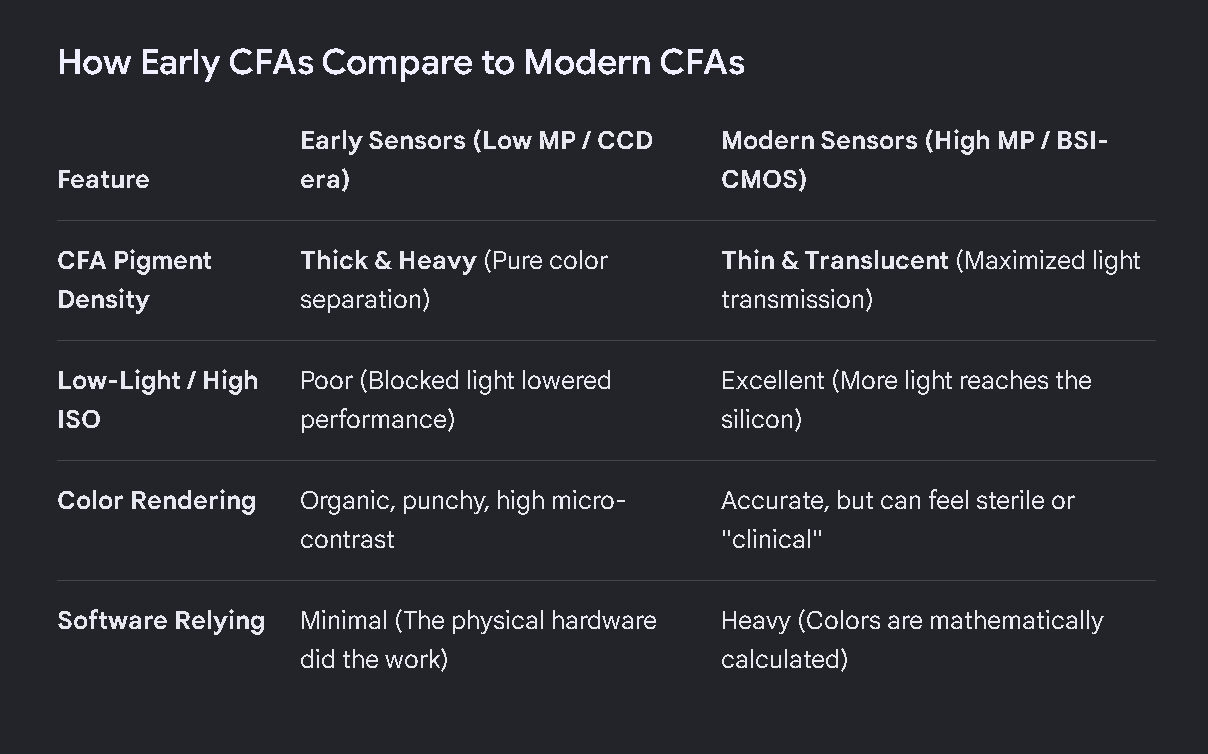
The "CCD vs. CMOS" Factor
While not strictly a pixel-size issue, many of those early cameras used CCD sensors rather than the CMOS sensors used today. CCDs processed the electrical charge differently, often leading to a global rendering that felt more film-like, with distinct micro-contrast that made colours pop in a way that modern, ultra-clean CMOS sensors sometimes flatten out.
So Why CCD? (Or cameras that proritise Colour)
Using older cameras has some obvious disadvantages. Some are so old now, the LCD monitors are hard to see by modern standards - they aren’t very large nor bright. Some old CCD cameras have gimped control interfaces as they were built for a consumer market (ala D60). Some don’t have focus motors built into the body, limiting use of lenses that have inbuilt motors, such as Nikon’s AF-S variants. Many are poor by modern standards in high ISO shooting. So why is it despite all these draw backs people still value their output?
They are very competitively priced now and can be found at low prices in mint condition
They can in the right hands, produce beautifully nuanced and saturated colours and a look of yesteryear
Many have fantastic JPG engines built in, meaning in some cases users can forego RAW for less technical shooting requirements. I use RAW for most of what I do, however JPG for many of my stock shooting business as I really don’t enjoy sitting editing for hours as much as I used to.
Many CCD cameras not only produce (subjectively) better out of the box colour than some costly modern cameras; they also produce a more organic, less digital, perhaps more rounded and filmic look than some of those crunchy digital sensors that need a lot of PP to get them how I like them
More realistic skin tones without green hues in them
Fewer metameric errors with difficult hues (purples, for example)
Unclipped strongly saturated colours next to accurately depicted weak colours,
Better colour accuracy under partial illuminants like incandescent and LED bulbs
It’s a ‘when you see it’ thing going on here. When you notice good colour (and conversely bad colour), you do think differently on the topic.
Ultimately, the interesting thing about these older cameras is not that they are universally better. They are not. A modern Z8, D850 or similar camera is vastly superior for many photographic tasks. The fascination comes from the fact that different design priorities produce different rendering characteristics. The D200, D700, D60 and similar cameras remind us that image quality is not only about resolution, noise, and autofocus. The way a camera interprets colour is part of its character.
CCD cameras, and retro cameras such as the D700, famous for excellent colour output are free to be judged by their own strengths. There are better cameras to shoot in the dark with and the like, better cameras to deal with sports and action etc, so now these cameras can play to their own unique strengths. Couple that with the fact most serious shooters can afford a backup body or two second hand, it can make perfect sense if your needs align.
If you enjoyed this article, consider following me on Instagram or Facebook.
D200 with 35/1.4